 Cat First
Do not waste time reading if the animal is not breathing or unconscious. Call a vet immediately.
Injured by a Child: First Aid and Prevention
If a child has thrown, dropped or squeezed the cat hard and afterwards there is blood from its mouth, marked lethargy or apathy, or it seeks out warmth, this is a critical condition. Such signs very likely point to serious internal injuries: a head injury, damage to internal organs (lungs, liver), internal bleeding, or a broken jaw or ribs.
Dangerous mistakes
- Bathing a cat in shock. Washing is an extreme stress. In traumatic shock the body temperature drops fast, and a bath makes the chilling and the shock worse and can stop breathing or the heart.
- Treating the cat yourself on advice from the internet. Time spent searching for information when there are signs of internal bleeding or shock directly threatens the pet's life. Human medicines given without a vet's prescription are usually toxic to animals: paracetamol and metamizole (analgin), for example, are deadly for cats.
Part 1. First aid
If you suspect a serious injury, the main task is to do no harm and to get the cat to a clinic as fast as possible.
Step 1. Keep the cat calm
- Settle the cat in a quiet, dimly lit, well-ventilated room.
- Put it in a carrier or a sturdy cardboard box with a flat, firm bottom lined with soft fabric.
- Do not shake, scold or keep moving the cat, and do not pick it up unless you have to.
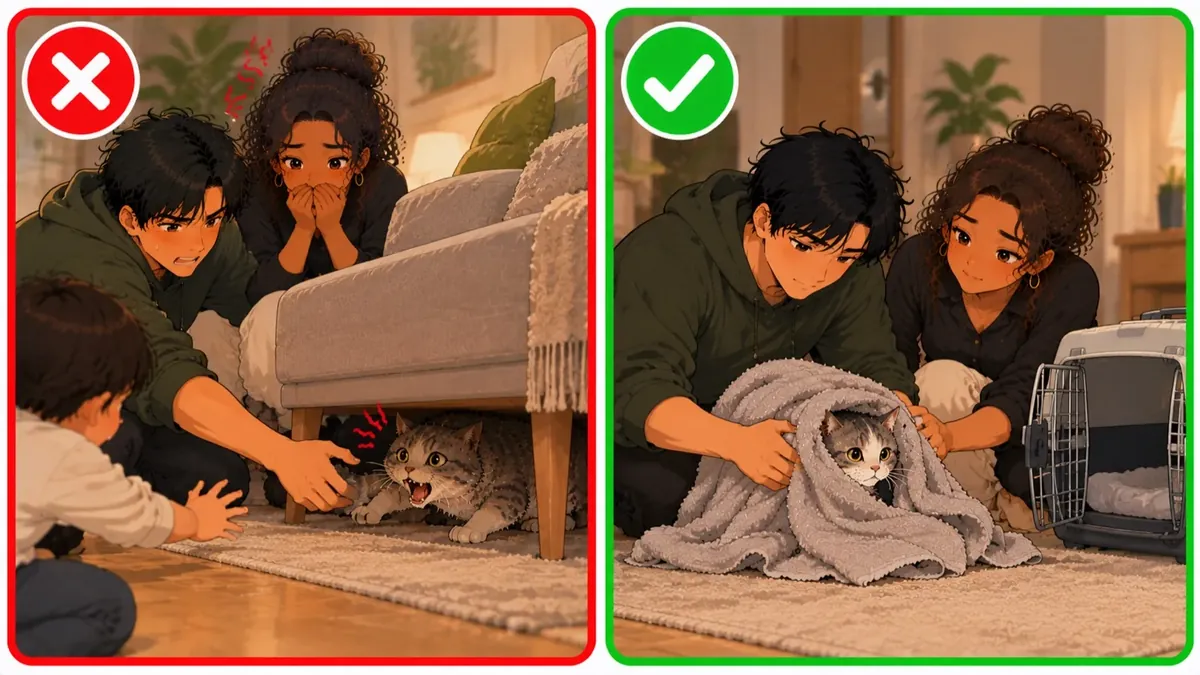
Step 2. Keep it warm
- In traumatic and hypovolemic shock the body loses heat quickly.
- Gently cover the cat with a light blanket or towel.
- If the paws and ears are cold (a sign of hypothermia), put a bottle of warm water next to it, always wrapped in thick fabric so it cannot burn. Do not overheat the cat or use water that is too hot.
Step 3. Check and hygiene
- Do not wash the cat! No water procedures at all.
- If there is visible external bleeding, gently press a sterile wipe or a clean bandage to the wound.
- Put a bowl of fresh water next to the cat. Never force water or liquid food into its mouth: if the swallowing reflex is impaired or the head is injured, the cat can choke.
Step 4. Get to a vet urgently
- The cat needs to be examined by a vet in person without delay. Take it to the nearest veterinary clinic and carry it as gently as you can.
- If you physically cannot leave right away, contact a vet at once through an online consultation service: they will tell you how to stabilize the cat.
- Do not give any medicines from your home first-aid kit until a vet prescribes them.
Part 2. Talking to the child and prevention
Children and pets living together need constant supervision and consistent upbringing.
Step 1. Explain the consequences
- Do not punish the child physically or shout: that only causes fear and aggression and teaches no understanding.
- Have a serious talk as equals. Explain that the cat is a living being and feels pain just like a person does.
- Use comparisons the child understands: "Remember when you fell and it hurt? The cat hurts even more now, but it can't tell us in words."
Step 2. Set clear rules
Agree on the limits and make sure they are kept:
- Touching. Not allowed: squeezing, throwing, pulling the tail, ears or paws. Allowed: stroking the back smoothly and lightly.
- Rest and sleep. Not allowed: waking the cat, pulling it out of its house or hiding place. Allowed: leaving the cat alone until it wakes up.
- Food and litter box. Not allowed: distracting, scaring, getting in the way. Allowed: simply staying away from the bowls and the litter box.
- Adult supervision. Not allowed: leaving children under 7 alone with the cat. Allowed: any contact only with an adult present.
Step 3. Teach gentle contact
- Show the child how to stroke the cat: with the fur, on the head and back.
- Explain which places must not be touched: belly, paws, tail, eyes and ears.
- Teach them to hold the cat properly: one hand supports the chest, the other supports the hind legs from below, so the cat never dangles in the air.
Step 4. Build empathy
- Involve the child in daily care for the cat, as suits their age.
- Give simple tasks: putting out dry food on schedule, changing the water in the bowl, tidying up the toys.
- Praise them for caring and being gentle.
The main thing
Full responsibility for the pet's health and for safe contact between child and animal lies with the adults. Children cannot always judge their strength or understand the consequences of what they do. The parents' job is to create a safe environment, react in time when the pet's health is in danger, and teach children to treat living beings with care and responsibility.
More in this section
The information in this app comes from open sources and the experience of cat owners. It does not replace a consultation or an examination by a vet. Decisions about your pet's health and care are the owner's to make — if in any doubt, contact a vet.