Cat First
Common Problems and Myths
Your cat isn't trying to make your life difficult on purpose. When she goes outside the litter box, hides, bites during petting, or tears through the apartment at night, it helps to start by asking yourself: “What is my cat trying to get, or get away from, with this behavior?” Very often, “strange” behavior turns out to be a perfectly understandable need: safety, control, an escape route, play, hunting, calm mealtimes, or a comfortable litter box.
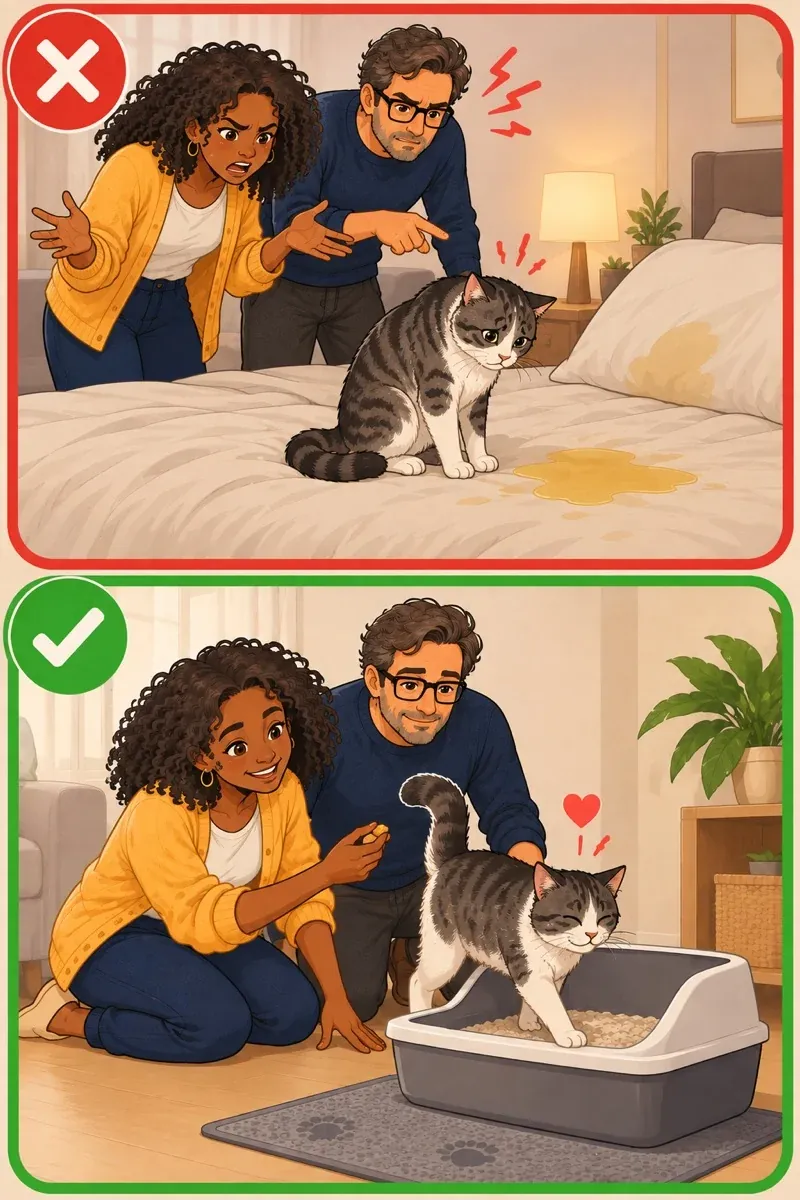
1. Cats don't miss the litter box out of spite
If your cat suddenly starts peeing or pooping outside the litter box, it's not an attempt to punish you. This behavior is much more often a sign that something is wrong with the cat or with its setup.
The cause could be pain, a urinary tract problem, stress, an uncomfortable litter box, the wrong litter, or conflict with another cat. Sometimes a cat simply starts choosing a different spot because it feels calmer there.
What should you do? If the behavior appeared suddenly, start by seeing a vet to rule out a medical issue. Then check the litter box itself: is it big enough, is it clean, is it in a good spot, and can the cat use it in peace without running into other animals?
Important: don't scold your cat or rub its nose in the mess. That won't explain what you want, and the added stress can only make the problem worse. Communicate with your cat in a way it can actually understand — with patience, not punishment.
2. Cats fishing food out of the bowl
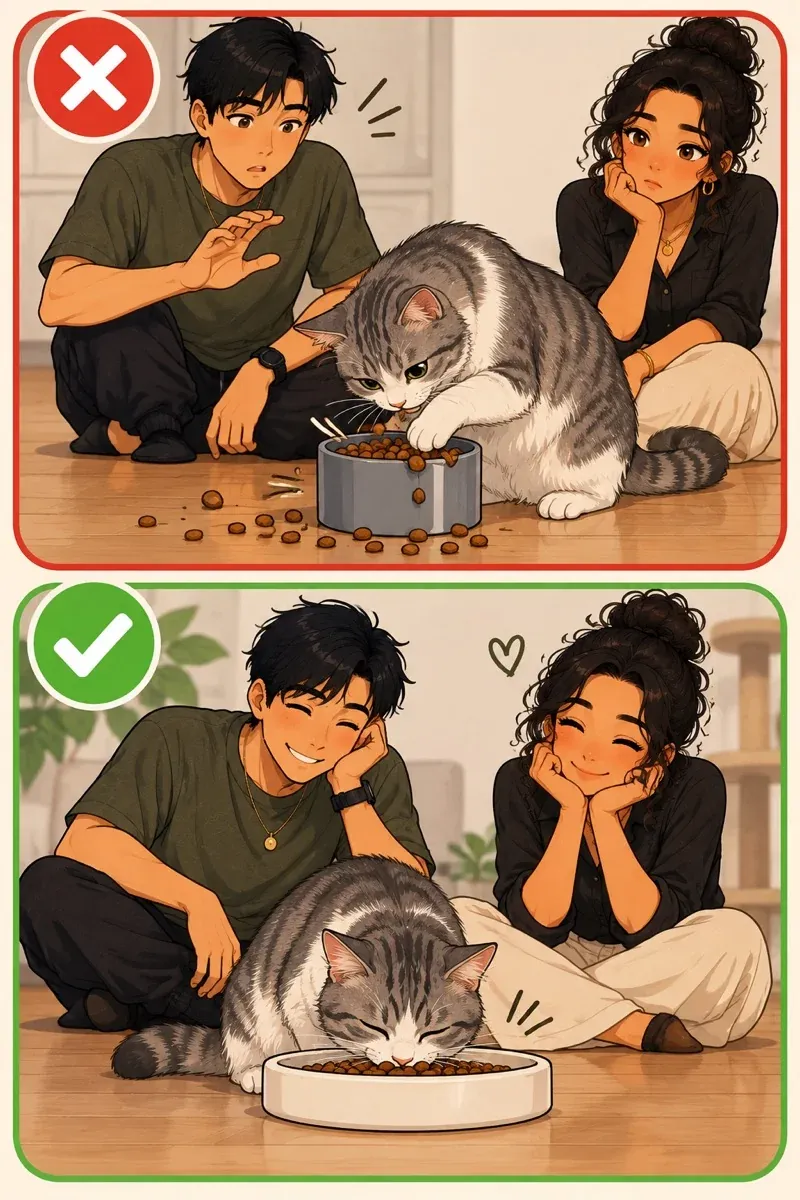
Cats really are very sensitive to anything touching their whiskers. That's why some cats prefer eating from a wide, shallow dish.
But the popular explanation involving “whisker fatigue” doesn't yet have solid scientific backing. One study on cats found no convincing evidence that an ordinary deep bowl causes them significant discomfort. That said, some cats did genuinely prefer a wide, shallow bowl.
So the simplest approach is to go by your own cat. If it constantly pulls food out onto the floor, only eats from the edge of the bowl, or clearly prefers a flat plate, try switching to a wide, shallow bowl. It's a cheap experiment that might make mealtimes easier for everyone.
One more thing: the bowl should be stable and easy to clean. Some cats also prefer eating somewhere quiet, where nothing disturbs them.
3. You moved the couch, and now the cat is on edge
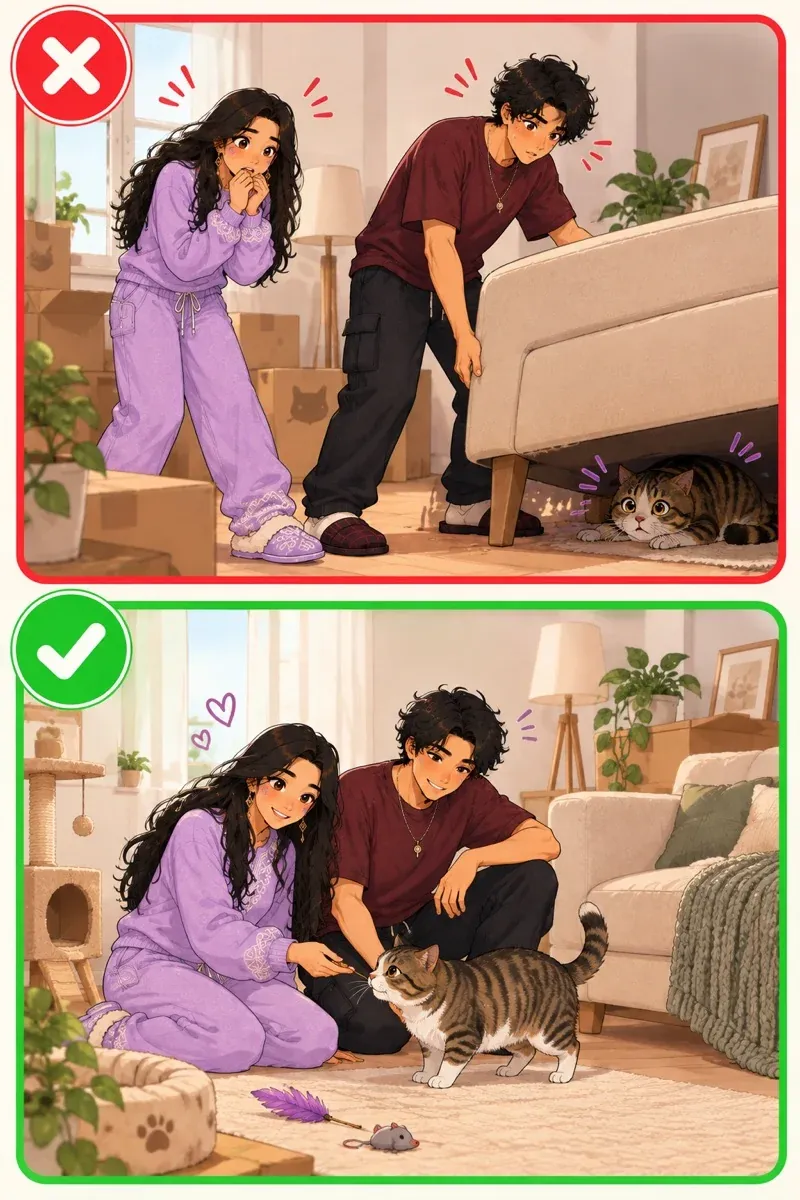
For us, rearranging furniture is just a change of decor. For a cat, home is a map of familiar routes, scents, resting spots, and safe points.
So big changes really can be stressful, especially if the litter box, feeding spot, or bed all move at once, or a favorite hiding place disappears.
That doesn't mean you can never move the couch. Cats are perfectly capable of adjusting to change. But if your cat tends to be anxious, it's better not to change everything at once — give it time to get used to the new layout.
If you're rearranging, leave a few familiar things in place: its favorite bed, hiding spot, scratching post, and access to its usual resources. After the changes, let the cat explore the new layout on its own terms.
It's especially important that it has somewhere to retreat to, where nobody will bother it.
4. Cats pull away from cuddles — and it's not because they don't love you
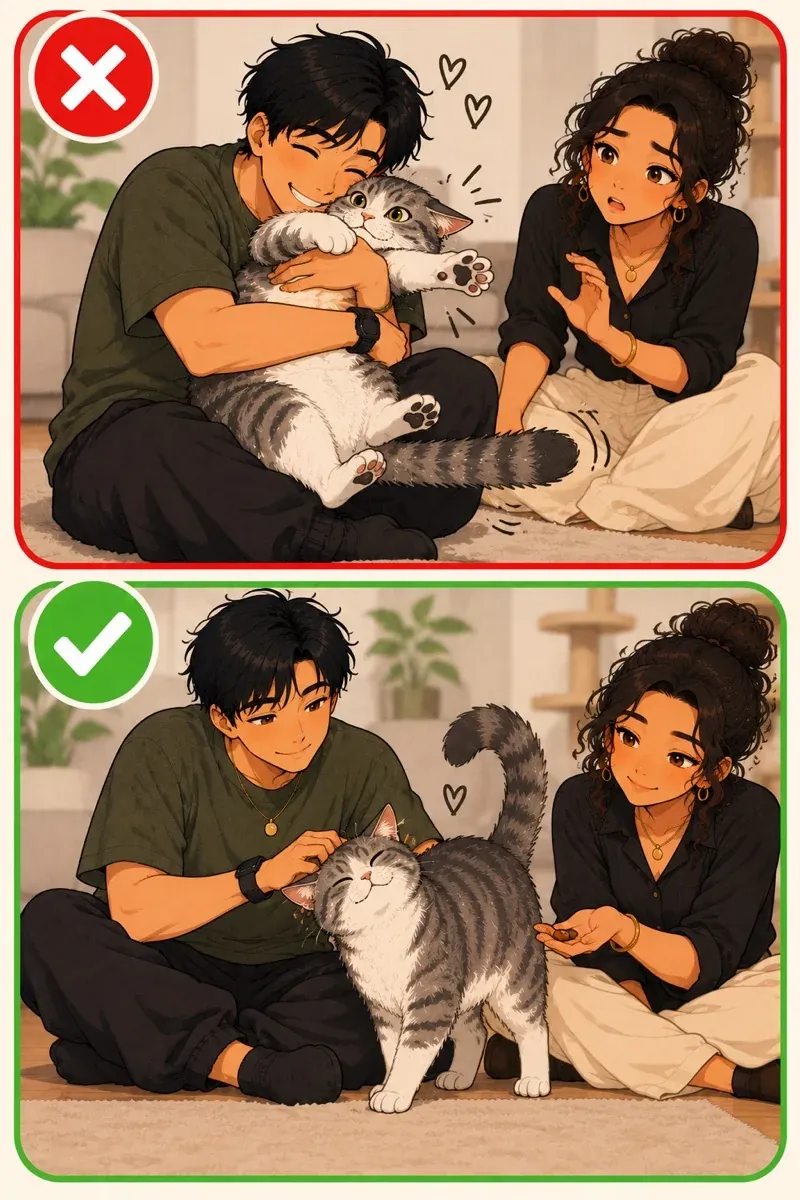
Many cats love being near their person but dislike being held down or petted for too long against their will.
If a cat starts turning away, tensing up, flicking its tail, flattening its ears, or suddenly grooming itself right after being petted, that can be its way of saying, “That's enough for me.”
A cat needs to be able to end the interaction whenever it wants. Research on cat behavior shows that interactions go more smoothly when the animal is given a choice and isn't forced to keep up the contact.
Try a simple rule: pet for a few seconds, then pause and watch the reaction. If the cat leans back into your hand, keep going. If it moves away, let it go.
This way, the cat gradually learns that it doesn't need to defend itself or put up with unpleasant touching around you. A favorite treat right after a petting session can also help build a bond — the cat learns that contact with you is pleasant and safe.
5. The cat sleeps all day and then gets the zoomies at night
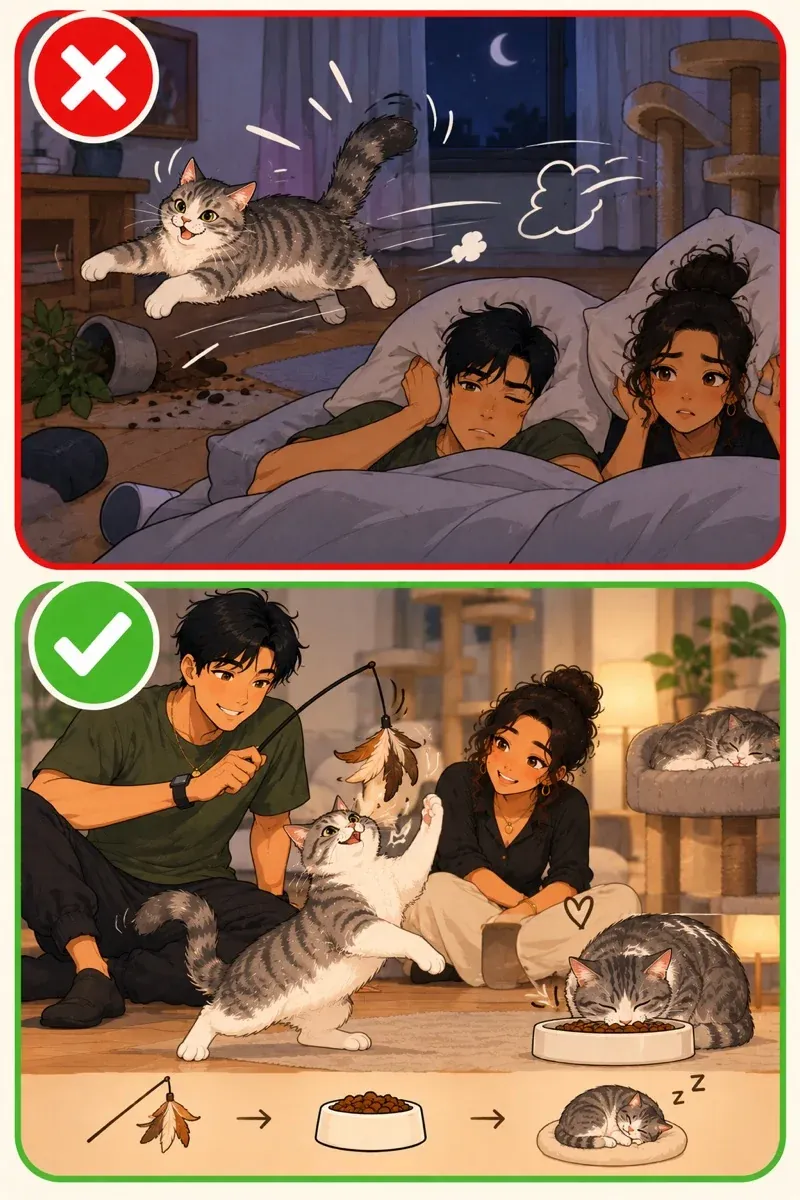
Cats aren't strictly nocturnal. Their natural activity levels tend to rise in the early morning and evening. So a cat sleeping during the day and then racing around the apartment in the evening is, on its own, completely normal.
The problem shows up when a cat has almost no chance to play, explore, and “hunt” for food during the day and satisfy its natural instincts. An indoor cat doesn't just need to lie on the couch — it needs activities that mimic natural behavior: stalking, chasing, searching for and catching its food.
What should you do? Don't get up every single time, talk to the cat, feed it, or start playing at 4 a.m. If every nighttime episode ends with attention or food, the behavior can become a habit — the cat learns that being loud at night really does get you out of bed.
It's better to shift that energy earlier in the evening. A few hours before bed, have an active play session with a wand toy or something else the cat can chase, then follow it with its regular meal. During the day, it also helps to leave options for independent activity: a scratching post, a high perch for watching the room, toys, and puzzle feeders.
At the same time, don't deliberately keep the cat from sleeping during the day to “tire it out” by nighttime — cats normally sleep many hours a day, and sleep itself isn't the problem.
One more important point: if nighttime yowling or restlessness appears suddenly, especially in an adult or senior cat, don't just chalk it up to personality — a sudden change in behavior can sometimes be linked to pain or illness and is worth a vet visit.
The main goal isn't to “ban the zoomies” — it's to make sure your cat has enough of the right kind of activity during the day and evening, so nighttime antics don't become a way to get your attention.
6. Cats don't need a stress-free life — they need somewhere to escape stress
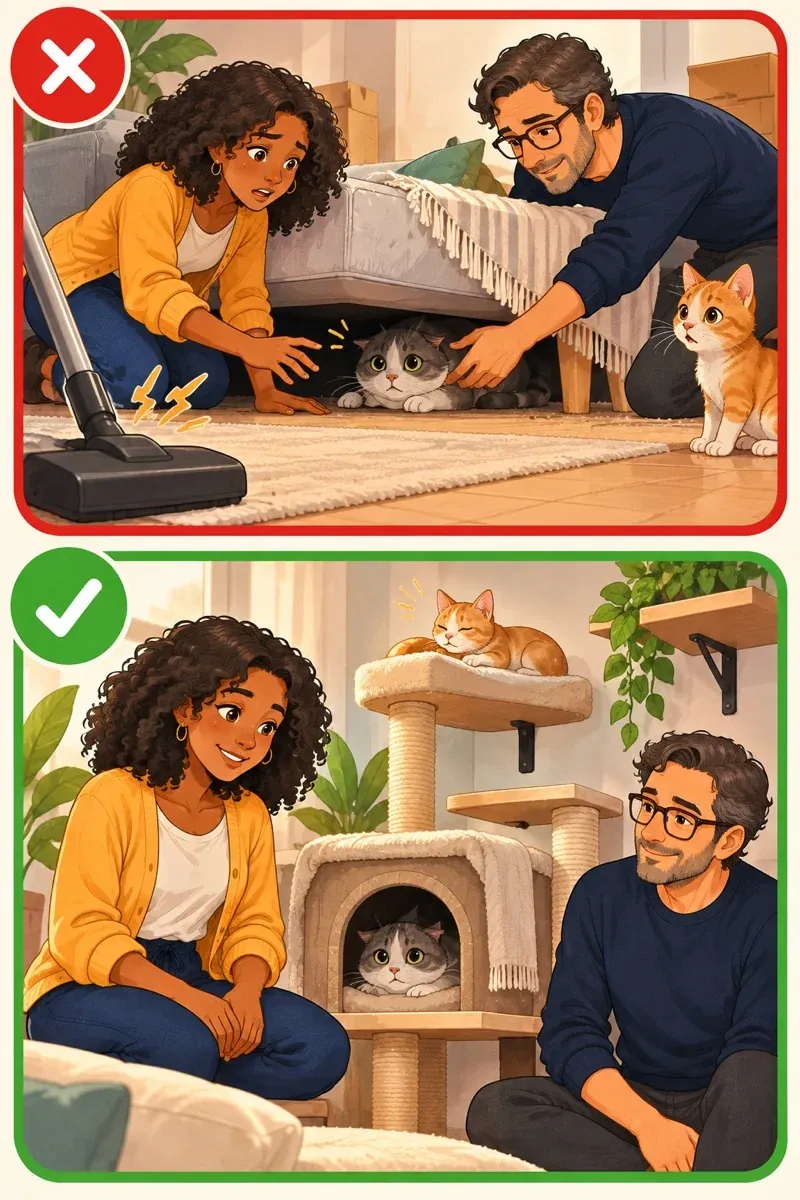
It's impossible to remove all stress from a house cat's life — there will always be guests, the vacuum cleaner, renovations, loud noises, the carrier, and vet visits.
Your job isn't to make the apartment perfectly quiet and unchanging. It's far more important to give the cat some control over the situation. If it's scared, it needs to be able to leave, hide, or climb somewhere high — research shows that having a hiding spot can genuinely reduce signs of stress in cats.
So it's worth setting up a few safe spots around the home. This could be a cat house, a box, a shelf, the top level of a cat tree, or just a quiet corner.
The main rule: if the cat has gone off to hide, don't pull it out just so you can spend time with it.
7. How to litter-train a cat?
With kittens, it's usually more accurate to talk not about “teaching” them to use the litter box, but about creating conditions where the box simply becomes the most convenient place to go — and the same principles apply to adult cats.
Cats naturally gravitate toward certain spots for their bathroom needs, but that choice is strongly shaped by where the litter box is, its size, how clean it is, the litter itself, and how safe the spot feels.
Start with the litter box itself. It needs to be big enough for the cat to turn around and dig comfortably — that genuinely matters to them. Vets often use this rule of thumb: the box should be about 1.5 times the cat's body length, from nose to tail tip. The entry sides shouldn't be too high, especially for a kitten.
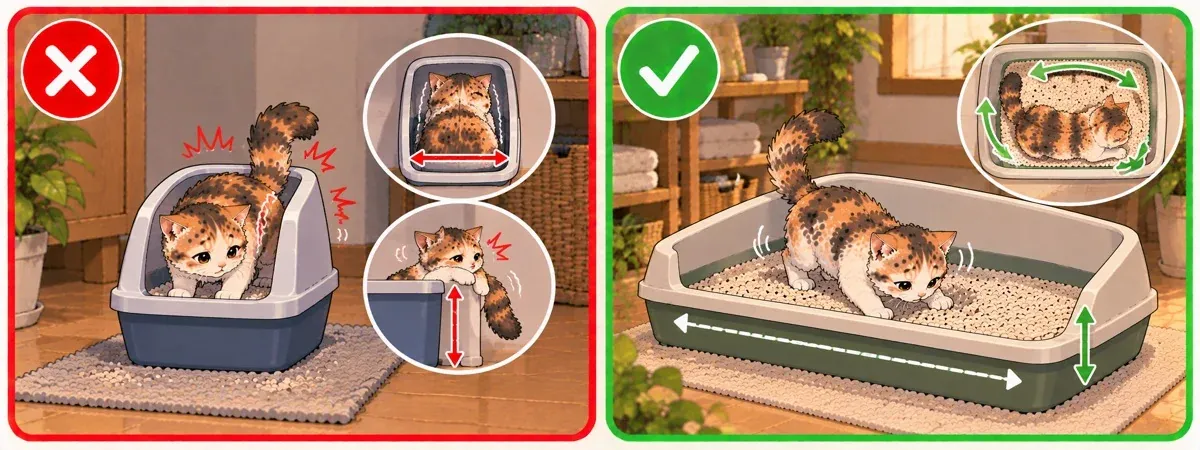
Put the litter box somewhere quiet and easy for the cat to reach — not next to the food and water bowls, and not somewhere it's constantly startled by noise, people, or other animals.

If you have more than one cat, a single litter box may not be enough. A common recommendation is one box per cat, plus one extra — and it's best to spread them around different accessible spots rather than lining them all up together.

Cleanliness matters a great deal. Scoop out clumps and waste regularly, and give the box a full clean from time to time. Skip strongly scented cleaning products — a smell that seems pleasant to you might not sit well with your cat.
If a kitten has just arrived home, you can gently place it near the litter box a few times after it wakes up, eats, or plays. But don't hold it inside the box, and definitely don't scold it.
Cats should never be punished for going in the wrong spot. That doesn't build a positive association with the box — it just builds stress.

If your cat goes somewhere else, make sure to clean the smell away thoroughly — otherwise that spot can keep drawing it back. If needed, place an extra litter box there temporarily, then gradually move it to where you actually want it.
And most importantly: if an adult cat that used the litter box perfectly well before suddenly starts missing it, that's no longer a “training” issue. Look for the underlying cause first — it could be a urinary tract problem, pain, digestive issues, stress, conflict with another cat, or an uncomfortable litter box. These cases are best worked through systematically, starting with a vet visit.
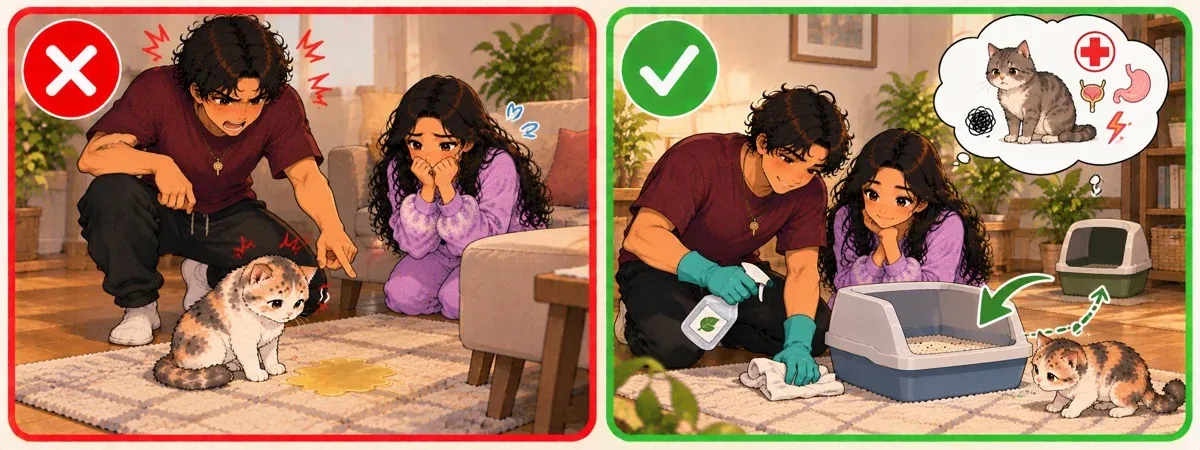
The rule is simple: for a kitten, provide a comfortable box and a calm introduction; for an adult cat that's suddenly stopped using it, start with a health check. That approach works far better than trying to “explain” to your cat where it's allowed to go.
8. How to litter-train a kitten
1. First, set up the right litter box. It needs to be big enough for the kitten to turn around and dig comfortably. For a small kitten, choose a low-sided box that's easy to climb into — a covered box isn't necessary at first, and an open one is usually easier for getting acquainted. Go with unscented litter; if the kitten is already used to a particular type (say, clumping clay or wood pellets), it's best to stick with that at first and switch gradually later. Keep in mind that kittens have small, delicate paws, so the litter needs to be comfortable to walk on — large, sharp granules can hurt their soft paw pads.
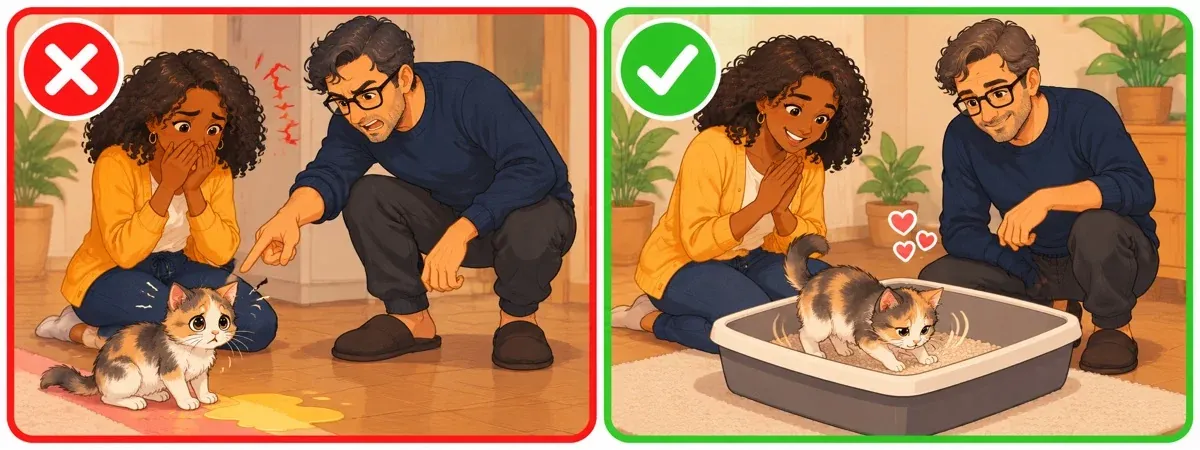
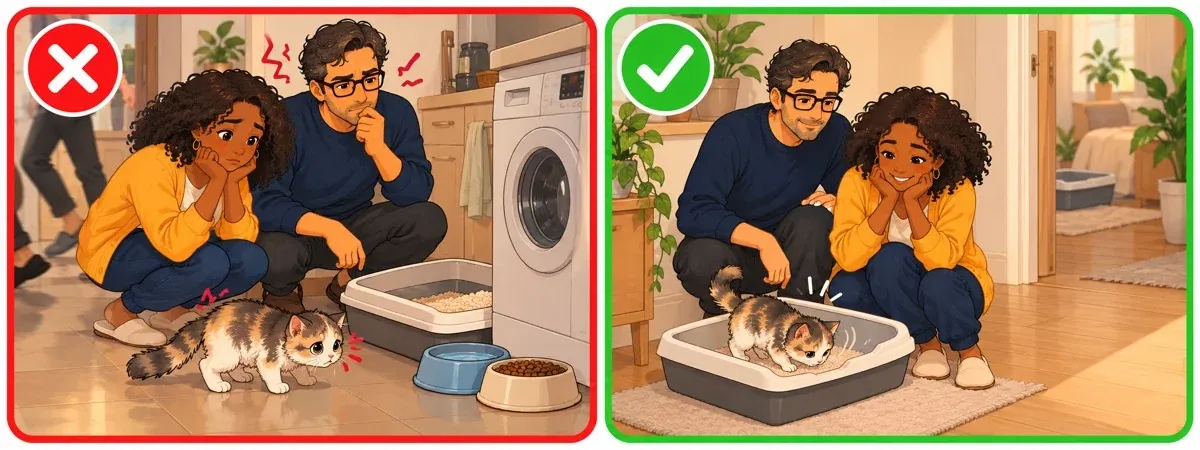
2. Put the litter box somewhere quiet. The kitten should be able to find it easily and reach it at all times. Don't put it next to the food and water bowls, near the washing machine, or somewhere people are constantly walking through. If you have a large home, it can help to set up a few boxes in different spots at first.
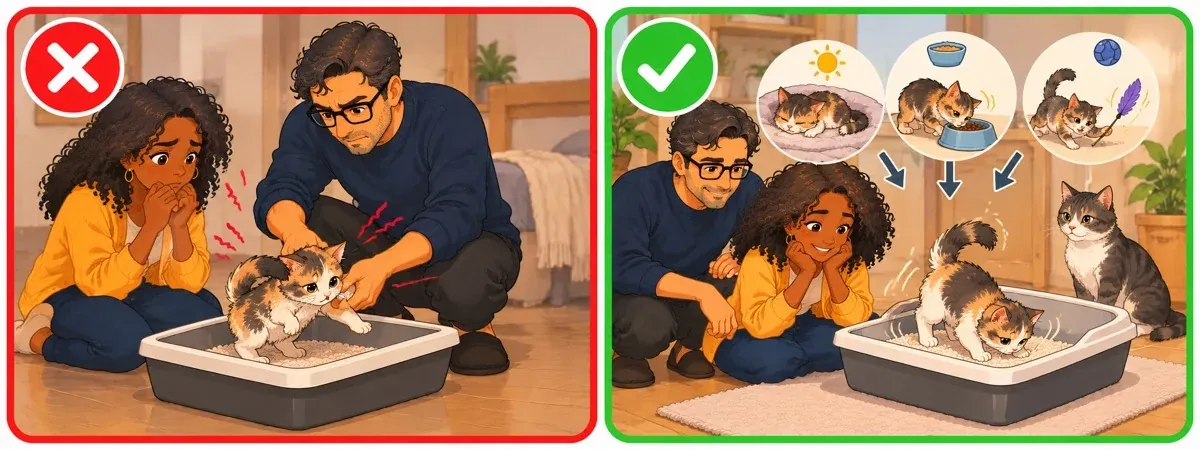
3. Show the kitten the litter box after sleeping and eating. This is one of the best moments for learning. After the kitten wakes up, eats, or has an active play session, calmly carry it over to the box. You can set it down inside and let it explore on its own. Don't move its paws through the litter to mimic “digging” — the kitten needs to figure out on its own that this is the spot for bathroom business. If there's already another cat in the house, the scent of an adult cat will actually help point the kitten in the right direction.
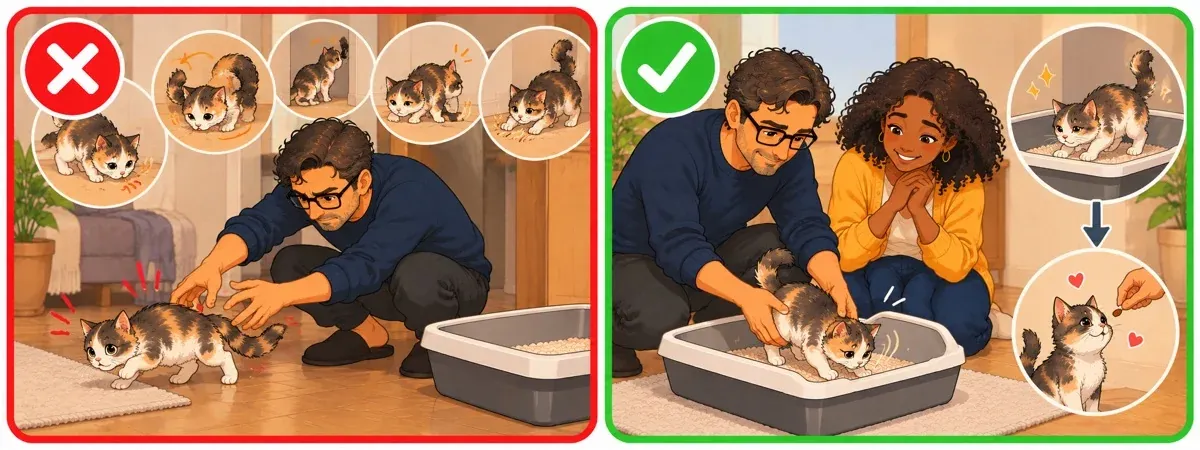
4. Watch for the signals. When the kitten starts sniffing the floor, circling, looking for a corner, crouching, or scratching at a surface, calmly carry it to the litter box. If it uses the box, don't interfere or scoop it up right afterward; you can quietly praise it and offer a treat to reinforce the behavior.
5. For the first few days, limit its space. If the kitten has just arrived home, you don't need to give it the run of the whole apartment right away. Start with a single quiet room that has the litter box, water, food, a sleeping spot, a hiding place, and toys. Once the kitten is reliably using the box, gradually open up the rest of the home — this makes it much easier for it to remember where the bathroom is.
6. Clean the litter box regularly. Cats can refuse to use a dirty litter box. Scoop out urine and feces regularly, and wash the box itself without harsh, strong-smelling products. You don't need to fully replace the litter after every single use — how often depends on the type of litter.

7. If the kitten has an accident, don't scold it. This is really important: don't yell, don't rub the kitten's nose in it, and don't punish it. It won't understand punishment as an explanation of the rules — it may just become afraid of you or of using the bathroom at all. Calmly clean up the spot and thoroughly remove the smell with a pet-odor cleaner made for this purpose. If the kitten keeps choosing the same corner, place a litter box there temporarily — once it starts using it, you can gradually move the box to where you actually want it, and the cat will usually follow along.
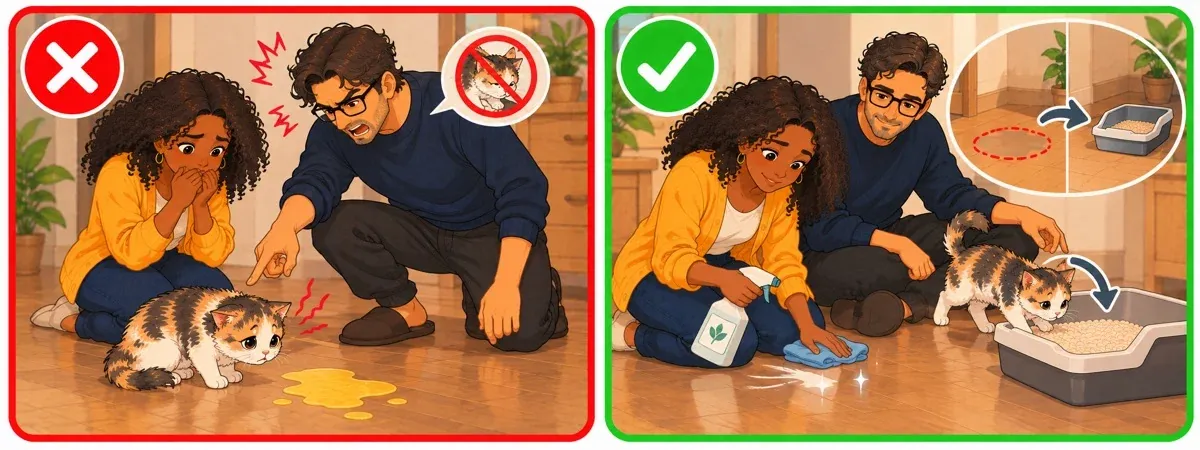
8. If accidents keep happening, look for the cause. That doesn't necessarily mean the kitten “didn't get it.” Possible reasons: the box is too small; the sides are too high; it doesn't like the litter; the box is in a noisy spot; another cat is blocking access to it; the box isn't clean enough; the kitten simply finds it hard to reach; or it needs a covered box with a door. If the kitten urinates frequently in small amounts, strains, cries while urinating, has blood in its urine, or suddenly stops using the box altogether, it's time to see a vet.
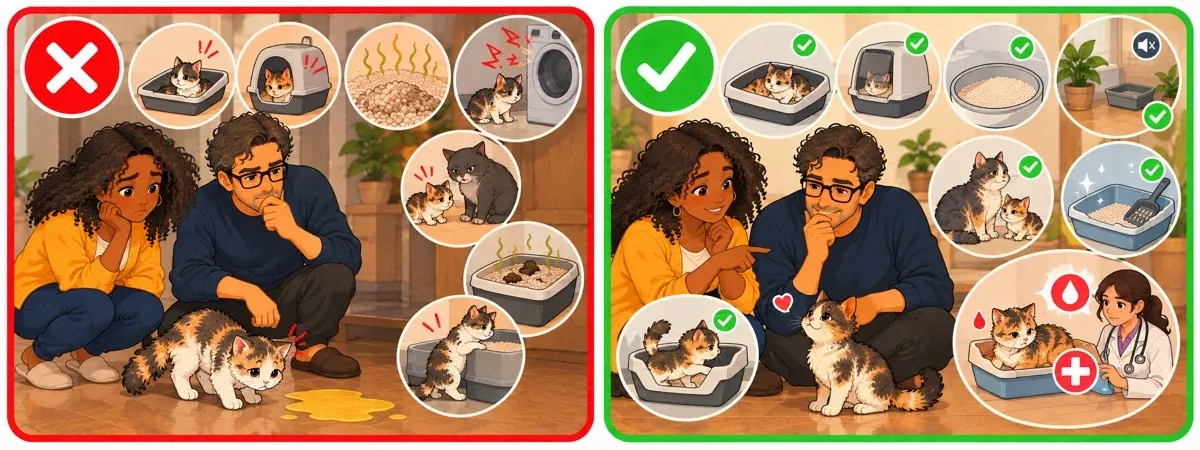
Simple routine for the first few days: wakes up → litter box; eats → litter box; plays → litter box; starts looking for a spot or crouching → calmly carry to the litter box; uses it correctly → praise; misses → clean up the smell without punishment and figure out why.
And most importantly: you don't need to “force” a kitten to use the litter box. Just make the box the most obvious, accessible, and comfortable place to go — that's usually all it takes.
9. How to tell if cats are really fighting or just playing
When two cats live in the same home, they may chase each other, grab each other with their paws and even bite. From the outside it can be hard to tell: are they playing, or is there a real conflict?
What matters is not one single moment but how the cats behave before, during and after contact.
If you want a short answer: if you can't tell whether they are playing or fighting for real, it is most likely just play. A real fight is obvious right away.
When it looks like play
During play, cats usually swap roles. One may chase the other and a few seconds later run away herself. Between rounds they can calmly part, do their own things and start playing again.
Even fairly noisy rough-and-tumble does not necessarily mean aggression.
When it looks like a conflict
Be alert if one cat keeps chasing the other while the second one keeps running away and trying to hide. Especially if there is hissing, growling, loud yowling, flattened ears, a tense body, puffed-up fur and sharp swats.
A good rule of thumb: if one cat clearly wants to end the contact and the other won't let her leave, it is no longer harmless play.
What the owner should do
Don't leave the cats to "sort it out themselves" if the conflicts keep happening. And definitely don't try to pull them apart with your hands — in that moment a cat may accidentally bite or scratch you.
It is better to calmly separate the animals, give them time to calm down and provide separate spaces.
Check whether there are enough resources in the home: litter boxes, bowls, beds, hiding places and places to retreat to. Sometimes a conflict starts not because the cats "don't like each other" but because one of them constantly feels pressure from the other.
If the problems keep coming back, consulting an animal behaviourist is an excellent solution. Remember: cats don't think the way humans do, and they see the world differently from us.
What matters to the cat
It is very important for a cat to be able to opt out of contact. She should know she can leave, hide, eat in peace or use the litter box without running into the other cat. Sometimes it helps to keep the cats in separate rooms, each with all the food, water and a litter box.
Yes, litter boxes can sometimes be in different rooms. The author of this project has a covered litter box in the bathroom, in the hallway and in the bedroom. It's all for the cats' comfort — and it really helps.
If a cat regularly hides, stops playing, eats worse or is constantly tense, that is a reason to take a closer look at the situation and, if needed, to contact a veterinarian or a cat behaviour specialist.
10. How to choose a good cat sitter
A cat sitter is not just a person who comes into the home and puts out food. While you are away, they effectively become the person responsible for your cat's everyday life.
That is why it is better to choose one in advance rather than on the last day before the trip. It is also important to be sure of the person and to have their contact details (and, ideally, details of their official documents).
Introduce them first
Ask the sitter to come over before you leave. Show them the home and tell them what a normal day with your cat looks like.
Pay attention not only to whether you like the person. Your cat's reaction matters too. Some cats go to say hello right away, others prefer to watch from a distance. Don't force her into contact.
A good sitter won't try to make friends with the cat at any cost. They can stay calmly nearby and respect her boundaries.
What to be sure to tell them
Leave a simple, clear set of instructions:
- when and how much to feed;
- where the water is;
- how often to clean the litter box;
- whether the cat likes to play and with what;
- whether she can be picked up;
- where she usually hides or sleeps;
- any quirks in her behavior;
- whether she takes medication.
Also leave the phone number and address of a veterinary clinic and your own contact in case something happens to the cat. It's best to prepare everything the cat needs for a trip to the vet in advance.
What to ask them to do during a visit
It's good if the sitter doesn't just leave food each time but really looks at how the cat is doing.
Ask them to check whether she has eaten, whether there is fresh water, whether she is using the litter box and whether she looks like her usual self. If the cat suddenly seems unusually listless, hides, refuses food or behaves completely unlike herself, it is important that they tell you.
A good practice is to agree on a short photo or video after every visit. It helps you understand how your cat spends her time without you (and lets you simply enjoy seeing your beloved pet).
Or you can set up cameras to watch through your smartphone.
Playing with the cat matters. If your cat gets along well with the sitter, it is better to ask for some activity with her on every visit.
The sitter may come once a day, several times a day, or even stay at your home while you are away. It all depends on your options and on the cat's needs.
Remember that a cat must not be left alone for long. Every visit should include some contact with a person: talking (so the animal hears a human voice), play, petting, or even sleeping on the guest's lap (sometimes a cat who is on her own needs that too).
Safety at home
Before you leave, put away medication, household chemicals, dangerous objects and anything the cat could accidentally swallow while she spends time without a person around.
Show where the carrier is and explain in advance what to do if the cat needs veterinary help.
Check the windows and balcony separately. A person who comes by once or twice a day may accidentally leave open something you normally keep closed.
What matters to the cat
For most cats the most comfortable thing is to keep their usual routine: the same food, roughly the same feeding times, familiar places and as few unnecessary changes as possible.
Your task is not just to find someone who will feed the cat. You need to find someone with whom the cat will feel as safe as possible while you are away.
11. When you adopt a cat from a shelter
Moving from a shelter to a new home is a big event for a cat. Even if she was friendly in the shelter and happily came to be picked up, her behavior at home can change completely.
She may hide under the bed, not come out to you, eat little or show no interest in toys at all. Sometimes it's the opposite: the cat starts following you everywhere and demanding attention.
This doesn't mean you are doing anything wrong. She simply needs time to understand what is happening now. What matters here is to give the cat time and the chance to adapt on her own by creating a safe and understandable space.
Where to start
Before the cat arrives, prepare a small, quiet space. It should have water, food, a litter box, a place to sleep and a hiding place.
You don't have to open the whole home to her at once. For a new cat a large unfamiliar territory can be too much. A small safe room helps her get used to the smells, sounds and new routine gradually.
When you bring the cat home, don't pull her out of the carrier. Open the door and let her come out on her own.
Don't rush the introduction
It is tempting to pet the new cat right away, pick her up and show her to the whole family. But it is better to wait a little. Remember: a person understands what is going on, but the cat doesn't.
Sit nearby, talk calmly and let the cat decide when she is ready to come closer.
If she has hidden, that is normal. Don't keep peeking under the bed or pulling her out. Every cat reacts differently: one will come out right away, another may stay hidden for a day or two.
It is important for the cat to feel that she controls the distance between herself and the person.
If there is already another cat at home
Don't simply let the newcomer into the shared room and expect them to become friends straight away.
It is better to keep the animals apart at first. They can get used to each other gradually through smells and sounds, and only then move on to meeting face to face.
This way both cats have less stress and more chance to calmly get used to the new situation.
You can read more about this in the app section "Introducing Two Cats in an Apartment".
What to watch for
In the first days pay attention to appetite, water, the litter box and general behavior.
Hiding and being cautious is normal. But if the cat doesn't eat for a long time, looks very listless, or develops breathing problems, vomiting, diarrhea or other noticeable symptoms, it is better not to wait for it to pass on its own but to contact a veterinarian. For a cat, going without food is dangerous even for a single day.
If you see that the cat is tense and doesn't come out to you, it is better to leave food in her room and go away for a while.
What matters to the cat
A new cat needs, above all, safety, quiet and predictability.
You don't have to get affection from her right away. It is much more important that she gradually understands: nobody is chasing her here, she has food, water, a litter box, a place to rest and a way to hide.
Trust usually doesn't appear in one day. Sometimes a cat needs a few days, and sometimes much longer. The most helpful thing an owner can do is give her that time and reward contact with treats.
12. Caring for a senior cat: what you need to know
The main rule: old age itself is not a disease. It is a natural process in which a cat's body changes and becomes more fragile and more vulnerable to various illnesses. If you treat your pet as "a normal cat, just older", you can miss important symptoms.
Age limits are approximate, but vets usually divide aging into three stages:
- 7–10 years — mature cat: unnoticeable changes begin in the body;
- 11–14 years — senior cat: chronic diseases often appear;
- 15 years and older — geriatric cat: the body becomes much weaker.
What changes with age
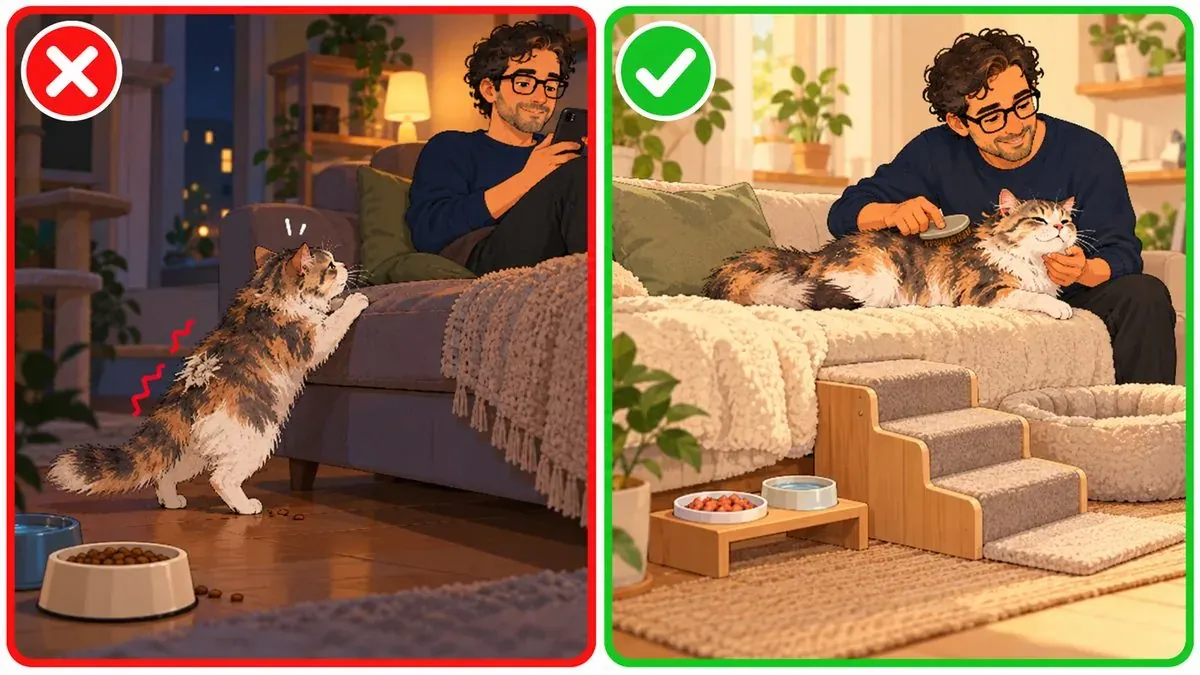
With age, cats lose muscle mass (this is called sarcopenia) and become weaker even if they are not ill. Because of arthritis, which affects 90% of cats over 12, jumping starts to hurt. Unlike dogs, cats rarely limp — they simply stop jumping onto high places and groom less, so mats can appear on their back.
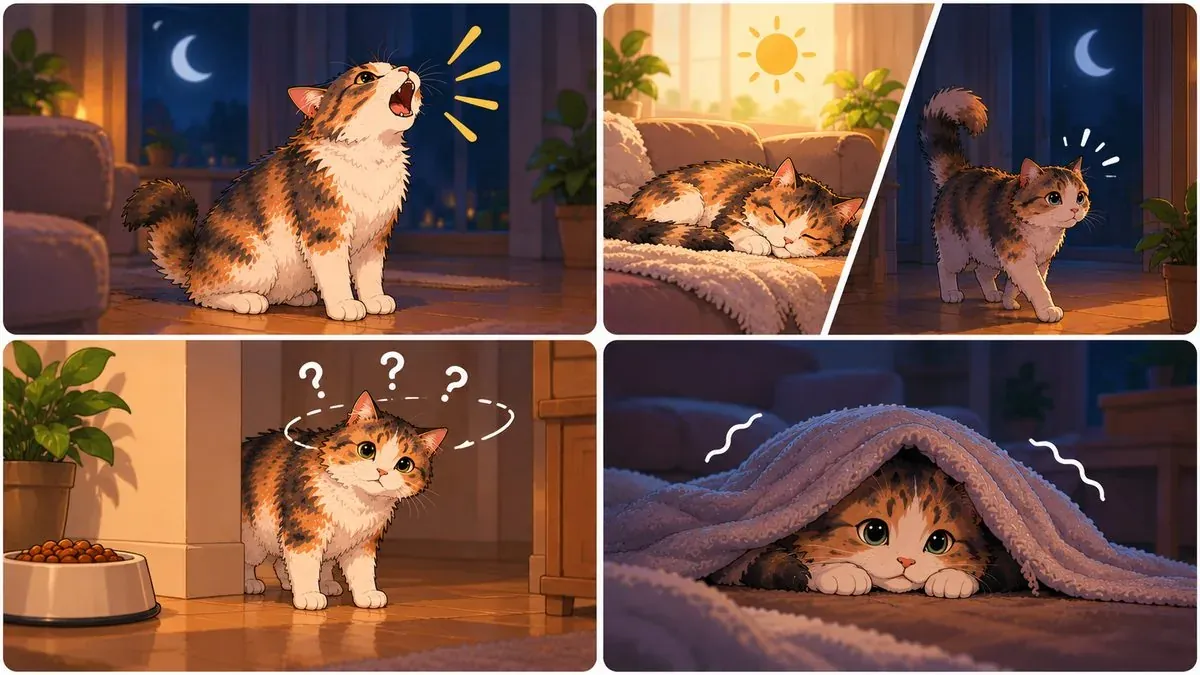
Sight and hearing also get worse: the cat may get frightened and meow loudly when it feels lost. Teeth deteriorate, and eating becomes painful. The stomach and intestines absorb proteins and fats less well. Sleep habits may change: the cat sleeps all day and wanders around the apartment at night.
Red flags: when to see a vet urgently
Don't put every oddity down to age. Some signs point to illness:
- drinks a lot and pees often — possible kidney problems, diabetes or thyroid disorders;
- hides and refuses food — the cat is in pain, nauseous or has inflammation;
- started going outside the litter box — this is often linked to joint pain (it's hard to step over the edge), frequent urination (the box gets dirty quickly) or the cat simply forgetting where the toilet is.
A special problem is feline dementia (cognitive dysfunction syndrome). It resembles Alzheimer's disease in people. Its main signs are easy to remember with the letters VISHDAAL:
- V (vocalization) — crying for no reason, especially at night;
- I (interaction) — the cat has become aggressive or, on the contrary, won't leave your side;
- S (sleep) — sleeps during the day and wanders restlessly at night;
- H (house soiling) — goes outside the litter box, sometimes right on its bed;
- D (disorientation) — gets stuck in corners, wanders aimlessly, can't find its bowl;
- A (activity) — plays less and stops grooming its coat;
- A (anxiety) — has become fearful, is afraid to be left alone;
- L (learning and memory) — forgets its name or the usual house rules: for example, stops responding to its name although it hears everything else.
Before diagnosing "dementia", the vet should check that the cat doesn't have high blood pressure or pain.
How to make your home comfortable for a senior cat
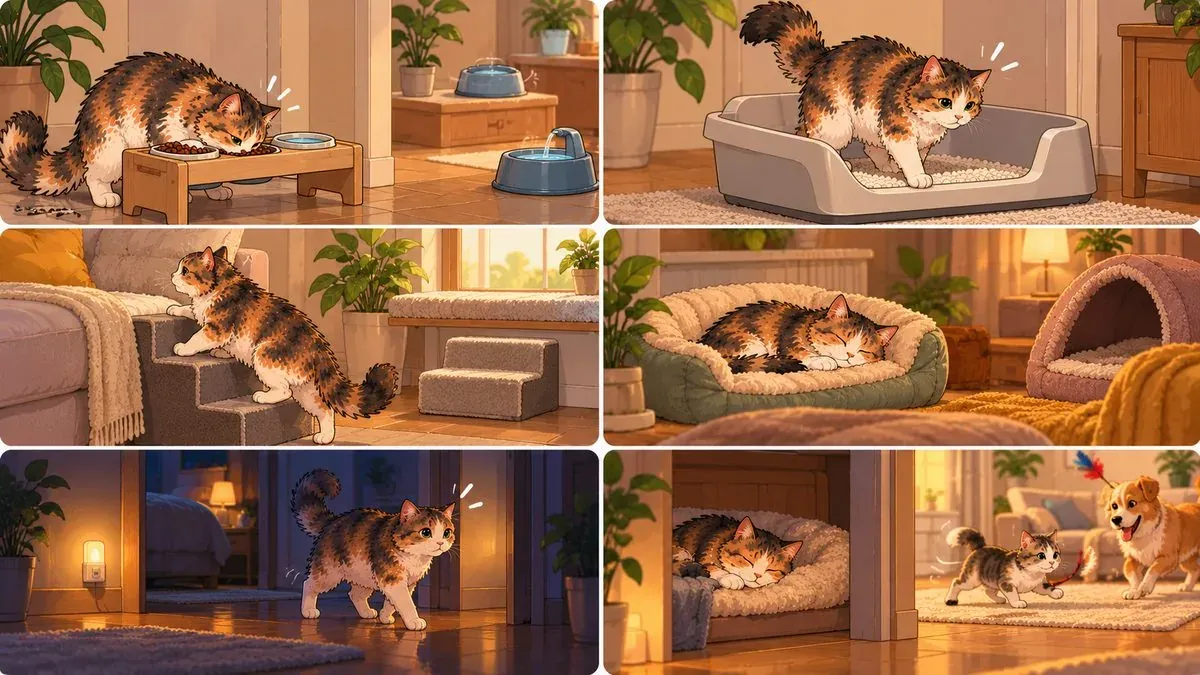
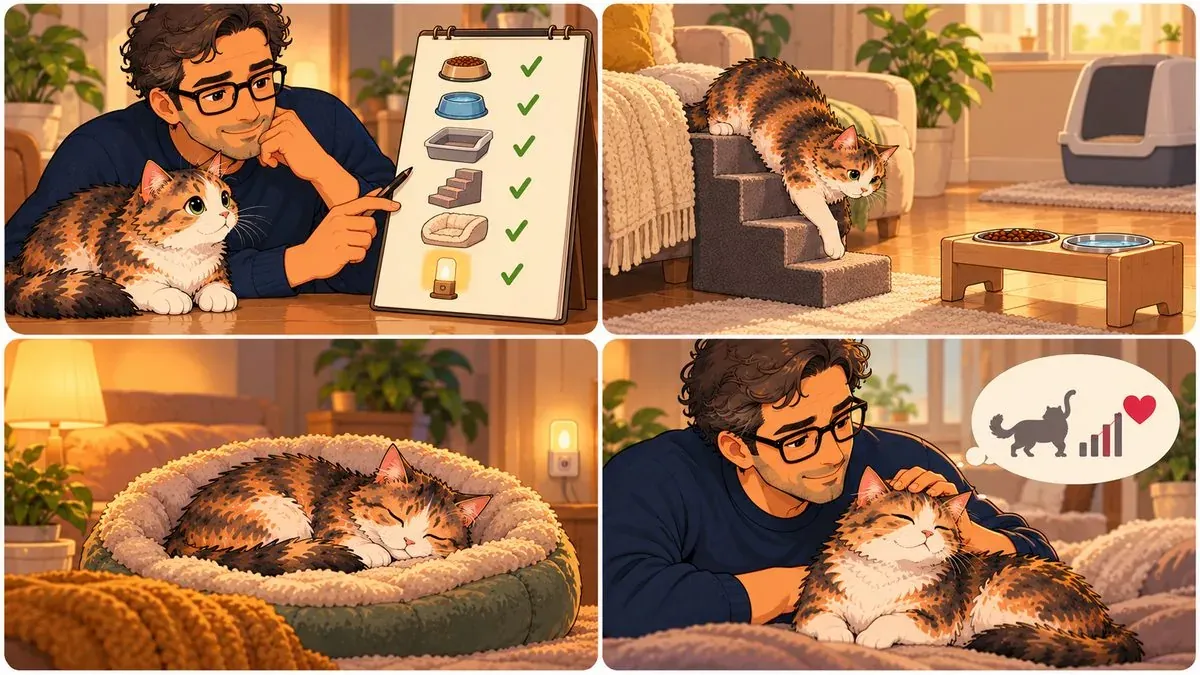
- Raise the bowls a little so the cat doesn't have to bend its neck much.
- Place water bowls all around the apartment so the cat drinks more.
- Buy a large litter box with a low entrance that's easy to step into.
- Put steps or ottomans next to sofas and window sills so the cat doesn't need to jump.
- Set up warm beds out of drafts in different parts of the apartment.
- If the cat has trouble finding its way, leave a night light on and don't rearrange the furniture.
- If there are other animals at home with a more active lifestyle, give the senior cat its own time and place where it can be alone in peace. Chronic stress leads to health problems.
Grooming and feeding
Be sure to trim the claws (with age they become brittle and can grow into the pads) and brush the coat regularly. Keep an eye on the stool: senior cats are often constipated because they don't drink enough. It's best to discuss with your vet in advance what to do in such situations.
Watch the cat's weight — it is the main indicator of its health. Don't switch to "Senior" food without your vet's advice. Healthy senior cats need more protein, while cats with kidney disease, on the contrary, need protein and phosphorus strictly limited.
Take the cat to the vet every six months: blood pressure should be measured and blood and urine tests done. If the cat's joints hurt, the vet may prescribe modern injections (for example, frunevetmab products such as Solensia) that relieve pain well and are safe for the kidneys and liver.
The most important thing is to prepare in advance and react to changes in time. Remember: cats don't have a big enough "safety margin" to endure problems for long without serious consequences, especially in old age.
13. If you can't keep your cat
Sometimes a cat has to be given away: allergies, a move, lack of money, a new baby or the pet's aggression. But before looking for new owners, it's important to understand: can the problem really not be solved?
Can the behavior be fixed?
Cats are most often given away because they pee outside the litter box. People think the cat is taking revenge, but in about half of cases it is simply ill: kidney stones, cystitis or joint pain.
How to tell illness from behavior problems:
How the cat pees
- Illness (cystitis, pain, stones): small puddles, with straining.
- Territory marking: standing, tail up, spraying on the wall.
- Dislikes the litter box: ordinary large puddles, just not in the box.
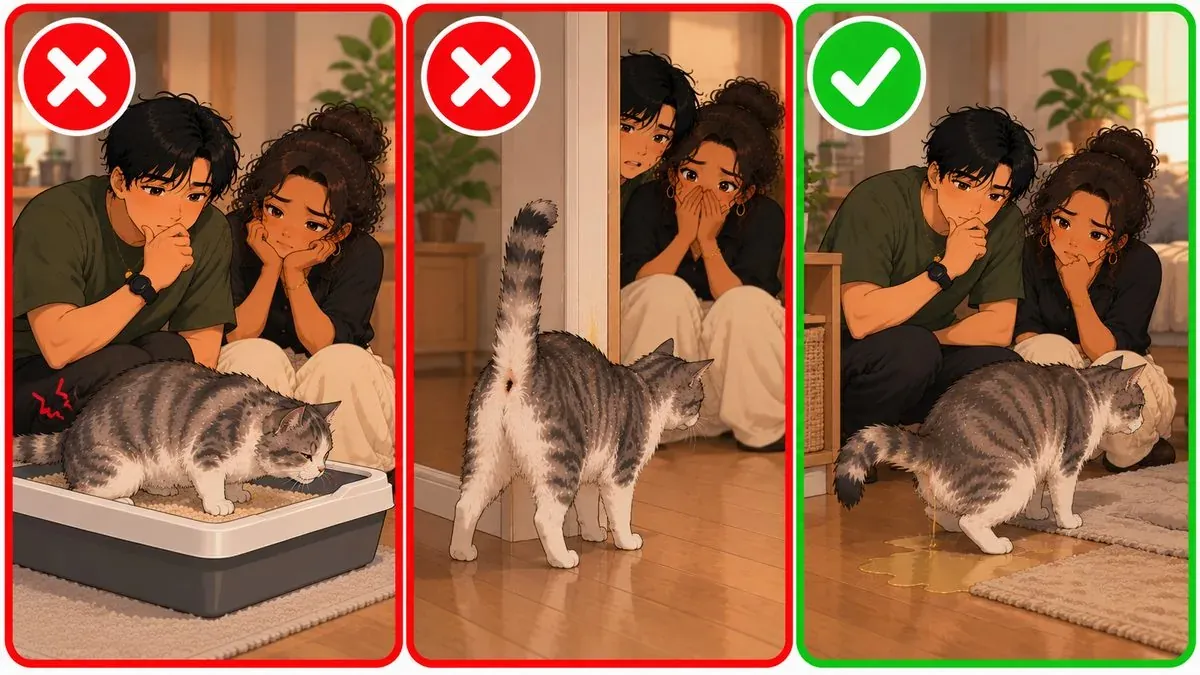
Where the cat pees
- Illness: anywhere, especially on cool (bathtub) or soft (bed) surfaces.
- Territory marking: on walls, doors, curtains.
- Dislikes the litter box: on carpets, furniture, in secluded corners far from the box.
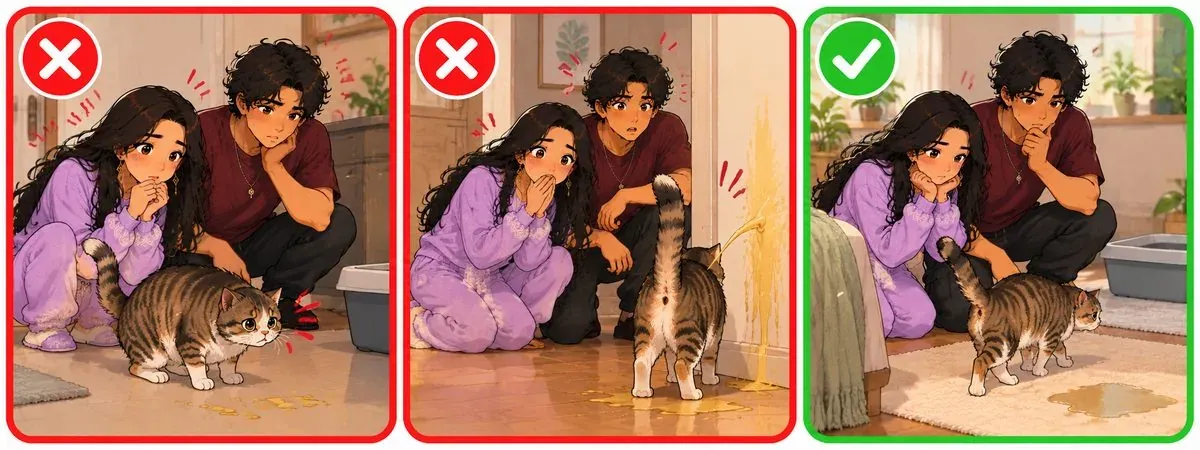
Attitude to the litter box
- Illness: sometimes uses it, but the box is associated with pain.
- Territory marking: poops in the box but pees both in it and elsewhere.
- Dislikes the litter box: refuses it completely or doesn't bury.
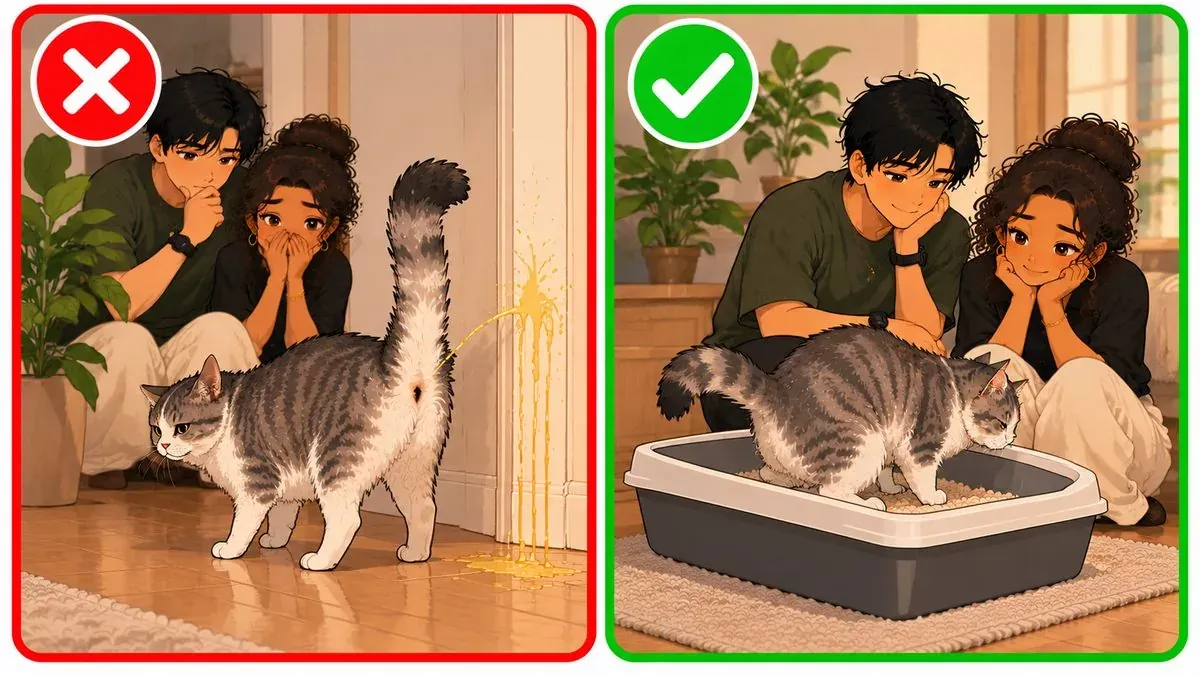
Behavior problems (marking, stress) can often be fixed on your own: put out more litter boxes, separate the feeding areas or use calming medication prescribed by a vet. In other cases an animal behaviorist or a vet will help.
How to find a new home the right way
If giving the cat away is unavoidable, prepare honest information: age, neutering, vaccinations, illnesses (especially feline leukemia or immunodeficiency), personality.
Take good photos and write a truthful ad. If you hide that the cat pees outside the box, it may simply be thrown out or returned to you, which is huge stress for the animal. It's important to stay honest.
Red flags when choosing a new owner:
- refuses to put nets on the windows (the cat may fall out);
- doesn't want to meet the cat in advance;
- refuses to sign a contract;
- plans to let the cat roam outdoors in the city;
- doesn't understand that good food and vet care cost money;
- is taking the animal as a gift for a friend, child or colleague;
- isn't ready to send photo updates for the agreed time.
Contract and handover
In Europe (and in many other countries) it's customary to sign an adoption contract (in German, Schutzvertrag). For the contract to be valid and for the cat not to be resold like "an object", it should state that you keep ownership or that the cat may not be passed on to third parties.
It's also customary to charge a small adoption fee (Schutzgebühr). Free cats are often taken by irresponsible people, resellers or animal abusers. To avoid giving the cat to abusers, check the person in advance with local charities and volunteers.
Be sure to give the new home the cat's litter box, its usual food, litter and favorite bed so that a familiar smell stays with it.
Emergency
Sometimes you need to act urgently: the landlord demands that the animal be removed, or you found a cat outside but can't take it home.
The main rule: never let a domestic cat out onto the street — it won't survive there, especially if it is injured or disabled. Volunteers have a rule: whoever finds the animal is responsible for it. Sometimes you need to act at once, without delay.
An action plan for an emergency, including with a cat from the street:
- first 24 hours — put the cat in a temporary safe place: a bathroom, a glazed balcony (if it's warm and a person can stay there in ordinary home clothes), a paid boarding place or friends;
- 1–3 days — if you found the cat outside, take it to a vet clinic and check whether it has a microchip: someone may be looking for it;
- the following weeks — look for its previous or new owners.
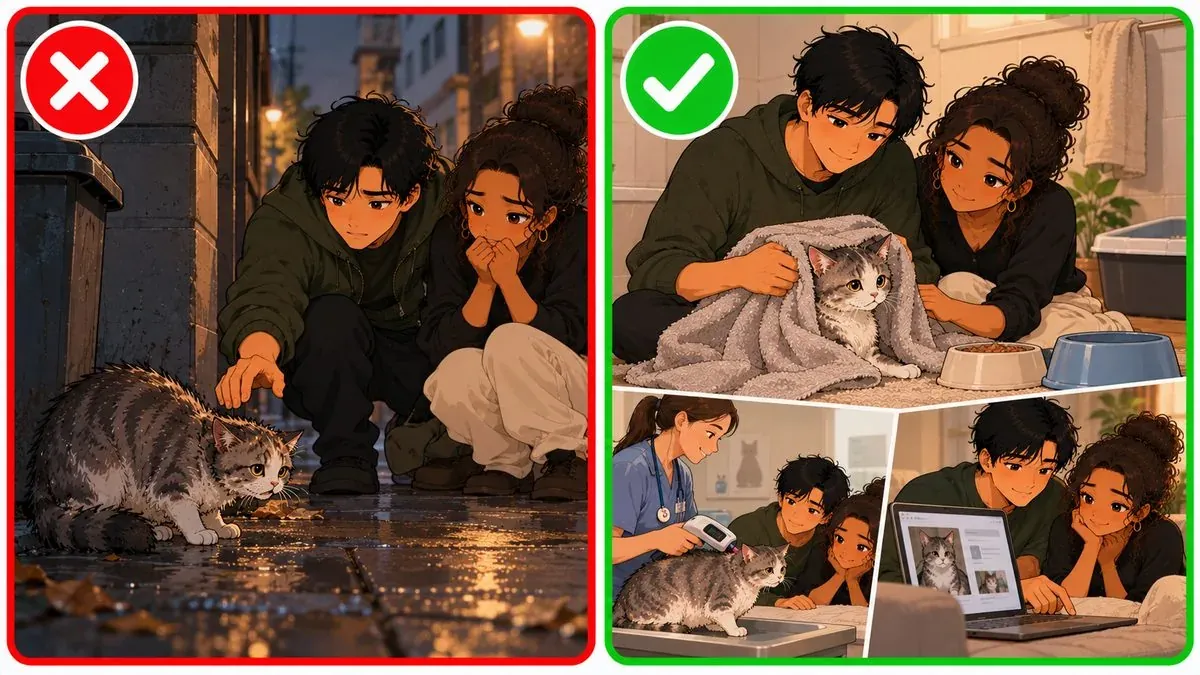
What to do if the landlord forbids pets
If you rent (especially in European countries such as Germany), learn your rights. Courts often side with pet owners: in Germany, for example, a blanket ban on dogs and cats in a standard tenancy agreement is considered invalid.
The landlord can't ban a cat "just because" — they need a good reason (for example, neighbours with a severe allergy). How to come to an agreement with the landlord:
- take out liability insurance that covers damage if the cat ruins something;
- offer an additional deposit;
- promise that the cat won't roam the stairwell or disturb the neighbours.
Sometimes it's enough to tell the owner what happened and show a photo or video of the animal. We are all human, and most people feel compassion when they see a cat in trouble. Don't be afraid to ask and try — an animal's life is at stake.
14. Cat allergy: what to do?
Allergy is not caused by the fur. The main allergen is the protein Fel d 1, found in a cat's saliva and skin oils. When a cat washes itself, it spreads saliva over its fur. The saliva dries, and microscopic protein particles spread all over the home, settling on furniture and curtains.
Symptoms vary: sneezing, watery eyes, itching or coughing. But pollen or dust mites cause exactly the same symptoms, so it's worth getting tested by an allergist first.
If you want to keep the cat
- Special food. There are now foods and supplements with antibodies to the allergen (they are obtained from egg yolk — makers with proven results are easy to find with a quick search). The antibodies neutralize the allergen right in the cat's mouth while it eats. After just three weeks there is about half as much allergen on the fur.
- Air purification. Buy an air purifier with a HEPA filter — it captures airborne allergen particles well.
- Cleaning. Keep the cat out of the bedroom, remove carpets and clean with a damp cloth regularly.
What doesn't work
- There are no "hypoallergenic" cats or cats without the allergen — even hairless Sphynxes produce it through their skin.
- There is no point in shaving the cat or bathing it every day: this only damages its skin, and there won't be less allergen.
If you have developed asthma, severe shortness of breath or swelling, don't risk your health. Ask a doctor about modern treatments — today there are many ways to cope with a cat allergy, and many people use them.
Important: this information is for educational purposes and does not replace professional advice. For a diagnosis and treatment (including medication for joints, kidneys or behavior), and to assess how severe an allergy is, be sure to see a vet or an allergist.
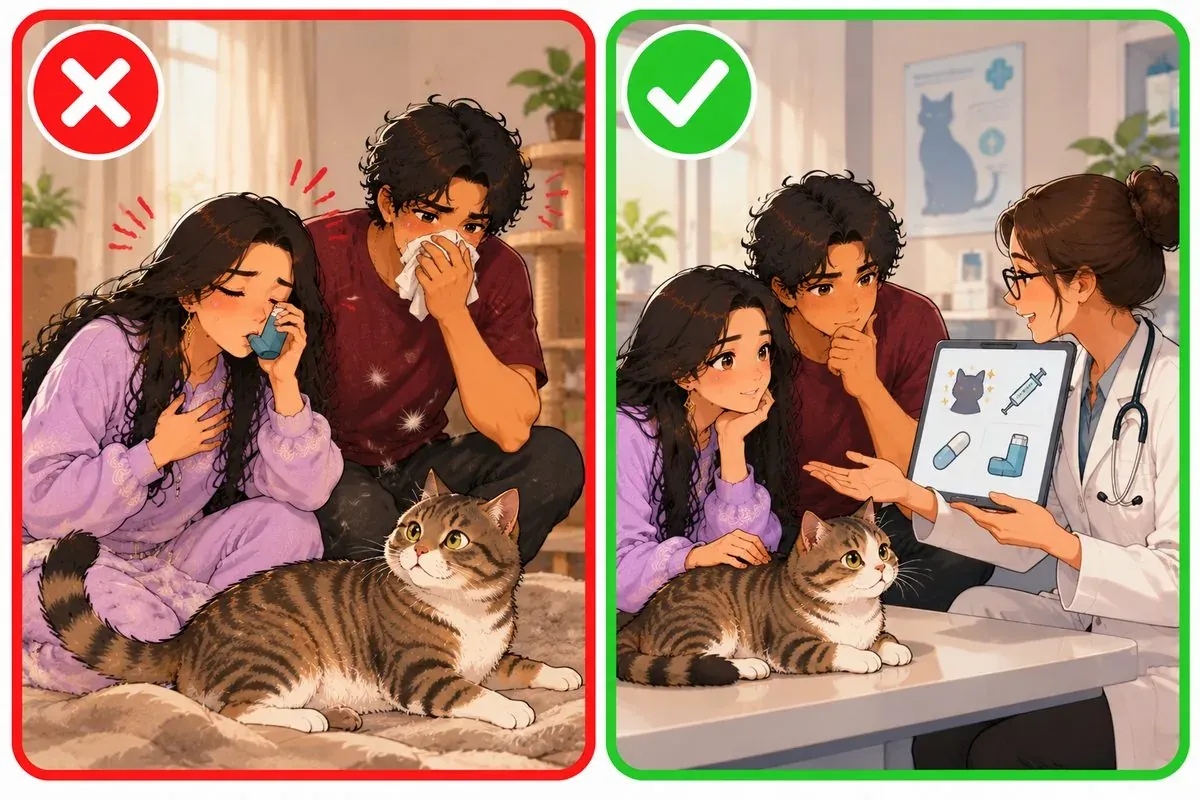
15. Children and cats: rules of behavior
Living with a cat brings a child a lot of joy and benefit: children learn care, empathy and responsibility. But cats are very sensitive. Noise, sudden movements and small children's unpredictability can frighten them badly, and that sometimes ends in scratches or bites.
For the cat and the child to become friends, don't leave it to chance. Parents need to prepare the home, set clear rules, set an example and learn to understand cat language.
Why a cat is not a toy
The most important thing to explain to a child from early on: a cat is a living being, it can be hurt and scared, and it has wishes of its own.
Small children (especially under five) can't yet judge their strength and may treat an animal like a stuffed toy: pull its tail or ears without understanding that it hurts.

Why it matters to stop this in time:
- Stress for the cat. If a cat is constantly squeezed and has nowhere to hide, it lives in constant stress. Because of that it may fall ill, refuse food, pull out its own fur or go to the toilet outside the litter box.
- Risk of injury. Unlike dogs, cats can't just put up with it and obey. A cornered cat will try to run away, and if there is nowhere to run, it will use its claws and teeth to defend itself.
- Raising kindness. If parents let a child hurt an animal, the child won't learn empathy. Set the right example: stroke the cat together, read kind books about animals and talk about what the pet is feeling right now. That way the child understands that a cat is a living being with complex feelings of its own.
Preparing for changes in the family
It all depends on whether you are expecting a baby while the cat already lives with you, or you are bringing a new cat into a home that already has children. Both need preparation.
If you are expecting a baby
For a cat, a newborn's arrival is a huge stress: new smells, sounds and rearranged rooms. Start preparing early:
- Play recordings of a baby crying and cooing: quietly at first, then louder, and give the cat treats so the sound is linked to something pleasant.
- Put baby lotion on your hands before stroking the cat so it gets used to the smell of baby products.
- If the litter box or bowls have to move to make room for the crib, move them a little each day.
- Introduce the new feeding and play schedule in advance, one you'll be able to keep after the baby is born.
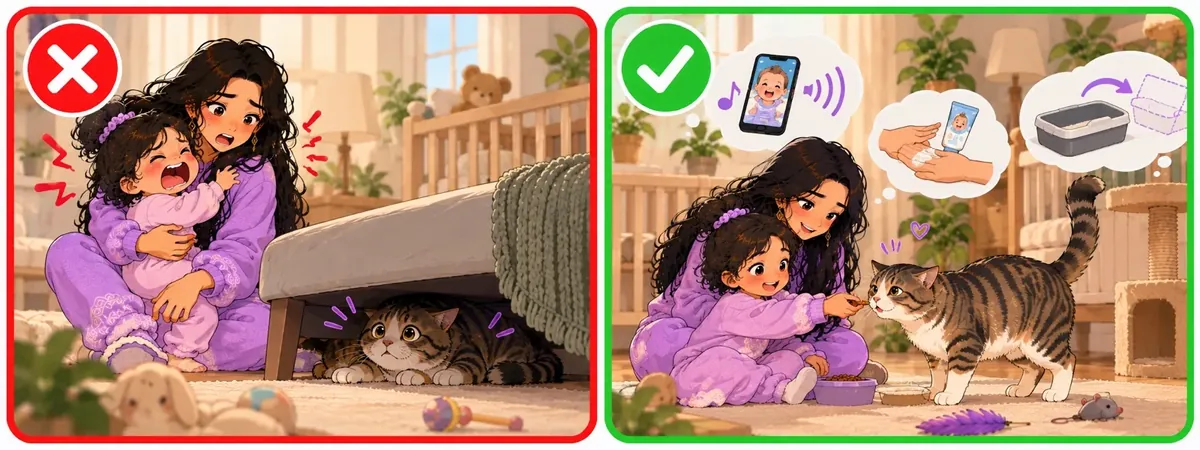
If you are getting a new cat (the "3-3-3" rule)
A new pet settles in by the rule of three threes:
- The first 3 days. The cat is very scared: it hides, eats little and doesn't want contact. What to do: leave it alone in a separate room with a litter box and food. Children must not go in. Don't pull the cat out of its hiding place.
- The first 3 weeks. The cat is getting used to things, exploring the home and forming habits. What to do: you can start introductions. Let the children sit on the floor and let the cat come up and sniff them by itself. Play with a wand toy.
- The first 3 months. The cat feels at home, is relaxed and asks for affection itself. What to do: full contact is fine now. Under supervision, children can start helping to care for the pet.
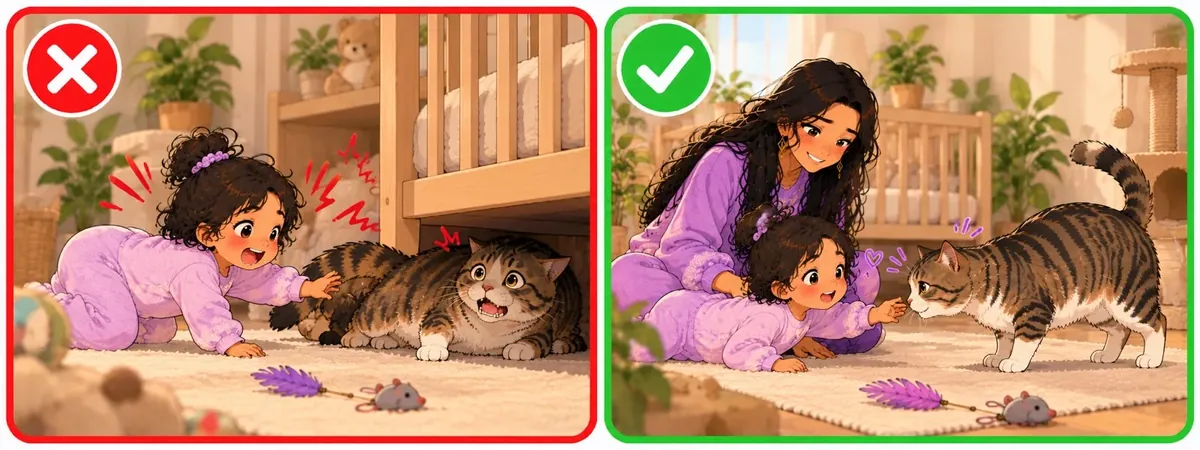
Introduce a crawling baby to the cat only when an adult is sitting right there and the cat is fed and calm. Let it sniff the baby: that's how cats get acquainted.
Safe zones for the cat
A cat must always be able to leave and hide. If it knows its escape route is open, it is much calmer.
- High places. Cats love to look at the world from above. Get a tall cat tree or put up wall shelves the child can't reach.
- Baby gates. Put safety gates in the doorways. The cat will jump over them or slip under, but the baby won't.
- Toilet and dining room. The litter box and bowls should be in a quiet place that children can't reach at all. If a cat is scared while using the litter box or eating, it may get ill or start going to the toilet elsewhere, on the bed for example.
5 main rules for being with a cat
Children should learn these rules by heart:
- Don't touch while it eats or sleeps. If the cat is sleeping, eating, drinking or in the litter box, it's as if it isn't there: no touching.
- Don't hold it by force. If the cat wants to leave, let it go. Don't chase it or keep it in your arms against its will.
- Hold it the right way. Little children must not pick the cat up. Older children may, but only properly: one hand supports the chest just behind the front legs, the other supports the bottom and hind legs. Never lift a cat by the belly, ears, tail or scruff: it hurts a lot.
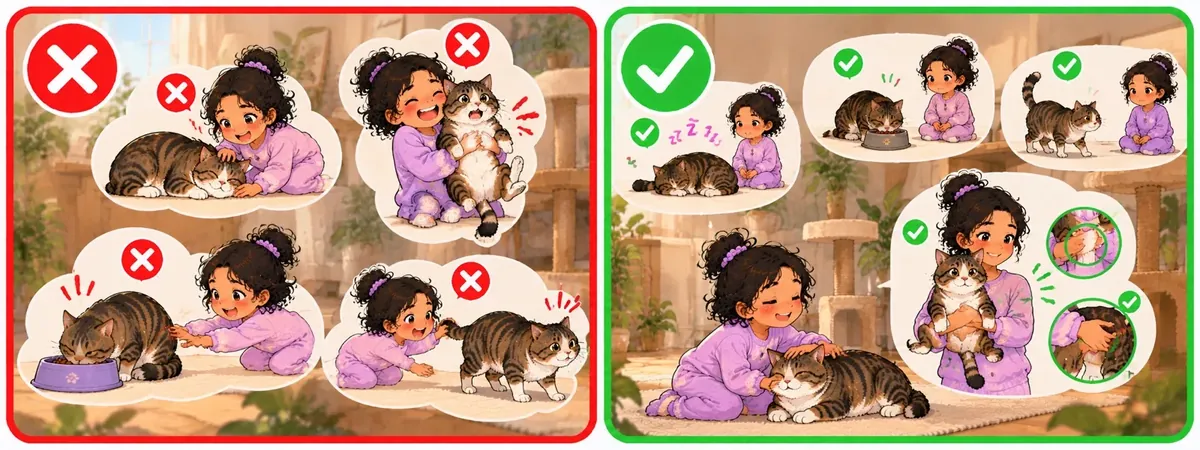
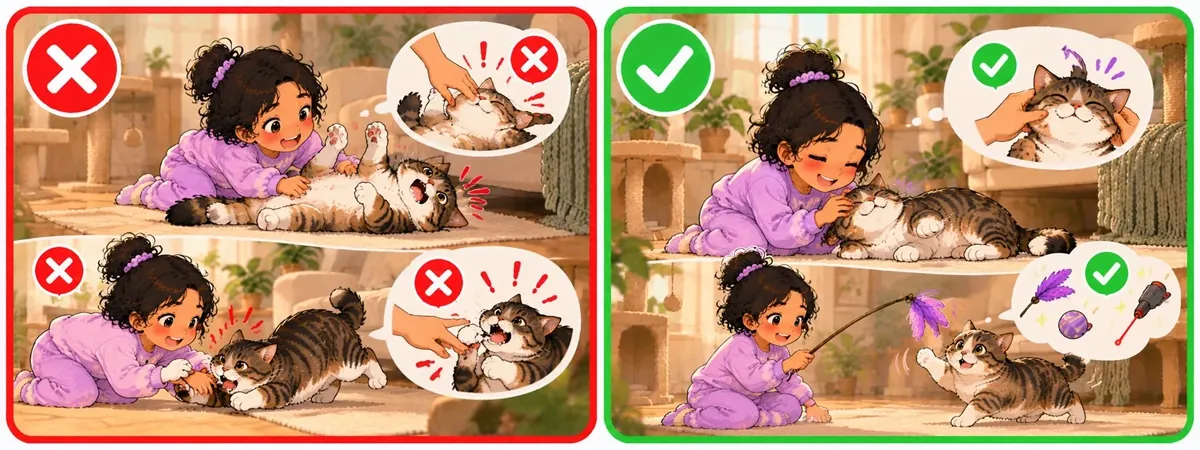
- The belly is off limits. A cat's belly is very sensitive. When a cat rolls onto its back, it is simply resting, not asking for a belly rub. Trying to stroke the belly often ends in a bite. The best places to stroke are the head, cheeks and behind the ears.
- Play only with toys. Hands and feet are not toys! If you play with a kitten using your hands, it gets used to hunting them and will bite painfully when it grows up. Use wand toys, balls and laser pointers.
How to ask the cat's permission (the 3-second rule)
The best way to make friends with a cat is to give it a choice.
Teach the child to hold out a finger towards the cat and stop without touching it. If the cat comes up by itself and rubs its cheek on the finger, it's happy to interact. If it turns away, don't touch it.
The 3-second rule: stroke the cat for three seconds and take your hand away.
- If the cat reaches after your hand and head-butts it, you can stroke it some more.
- If it just sits there, washes itself or walks away, it has had enough and contact should stop.
This approach makes cats very affectionate, because they feel safe.
How to tell a cat is nervous: cat language
Cats rarely attack without warning. Parents should teach children to notice the signs of displeasure.
Odd behavior to calm down: if after a noisy game the cat suddenly sits down and starts licking itself quickly and nervously, or yawning, it is trying to calm down after strong stress. Better not to touch it at that moment.
The cat's three mood levels:
- Green (calm). Normal pupils, the cat blinks slowly. Ears point forward, the body is relaxed, the cat purrs. What to do: you can stroke it (by the 3-second rule) and play.
- Yellow (stress and warning). Huge round saucer pupils. Ears flattened or turned out to the sides ("airplane ears"). The skin on the back twitches, the tail lashes sharply from side to side. What to do: step away immediately, the cat is getting ready to defend itself. Don't try to soothe or stroke it, just leave it alone.
- Red (aggression). Hissing, growling. Back arched, fur standing on end. The cat swipes with its paw or lunges. What to do: this is dangerous. An adult must take the child away. Never touch the cat with your hands. Give it a couple of hours to calm down in quiet.
Important: sometimes a cat gets fed up with being stroked for too long, as its skin becomes oversensitive. If during stroking it stops purring, the skin on its back starts twitching or its tail starts thrashing, take your hand away immediately, or a bite will follow.
Keep in mind: purring doesn't always mean a good mood. Cats also purr under strong stress or in pain, to soothe themselves. Always look at the situation and the cat's behavior as a whole.
Help from scents (pheromones)
If the home is noisy and the cat is nervous, special plug-in diffusers can help (Feliway, for example). They release substances similar to cats' natural calming scents. Studies suggest that such diffusers can help cats feel less nervous, scratch furniture less and go outside the litter box less often.
How children can help, by age
Manageable tasks help a child become more responsible, but everything has to suit their age. In any case, the main responsibility for the animal lies with the adults.
- 0–5 years. The child moves abruptly, doesn't understand they are causing pain and may put things in their mouth. Constant adult supervision is needed. The child doesn't pick the cat up. They can put the cat's toys away in a basket and stroke the cat with one finger while an adult guides their hand. No going near the litter box! The cat must have places where it can hide from the child.
- 6–12 years. The child can already empathize and understands the rules. They can pour fresh water and put out food by themselves, teach the cat simple tricks for a treat and play with it using a wand toy. From about 10–12 they can clean the litter box, but must wash their hands thoroughly afterwards.
- 13 and older. A teenager understands the pet's needs and becomes a full partner. They can take on almost all of the care: cleaning the litter box, buying food, going to the vet (together with an adult).
Health: what to do about scratches and bites
Even in good relationships, injuries happen. Parents need to know about the two main dangers.
Cat scratch disease
It is caused by bacteria carried by fleas: flea droppings stay on the cat's fur and claws. If the cat scratches a child (or licks a wound), the bacteria get into the blood.
- Symptoms. After 1–3 weeks a small pimple may appear where the scratch was, and then the lymph nodes (in the armpits or on the neck) swell a lot. There may be a mild fever.
- Treatment and prevention. The illness often goes away by itself, but sometimes antibiotics are needed, prescribed by a doctor. Protection comes from handling the cat properly, regular flea treatment (even if the cat never goes outside) and trimming its claws. Vaccinations on schedule are a must too: they protect against other dangerous infections.
Cat bites
Cat bites are far more dangerous than scratches. The sharp, thin teeth work like a syringe: they drive bacteria from the saliva deep under the skin, as far as the joints and tendons. The wound closes quickly on the surface, while a severe inflammation starts inside.
- Symptoms. The bite area turns red, swells badly and hurts within 3–12 hours.
- What to do. Immediately wash the bite with soap under running water for at least 15 minutes to rinse out the saliva.
- If the teeth broke the skin, be sure to take the child to a doctor the same day.
Important: this information is for educational purposes and does not replace a specialist's advice. For medical advice, diagnosis and treatment, be sure to see a vet, and for the child's health, a doctor.
More in this section
The information in this app comes from open sources and the experience of cat owners. It does not replace a consultation or an examination by a vet. Decisions about your pet's health and care are the owner's to make — if in any doubt, contact a vet.
All of this is in the Cat First app
Articles, checklists and first aid on your phone, even without internet.