Cat First
Behavior
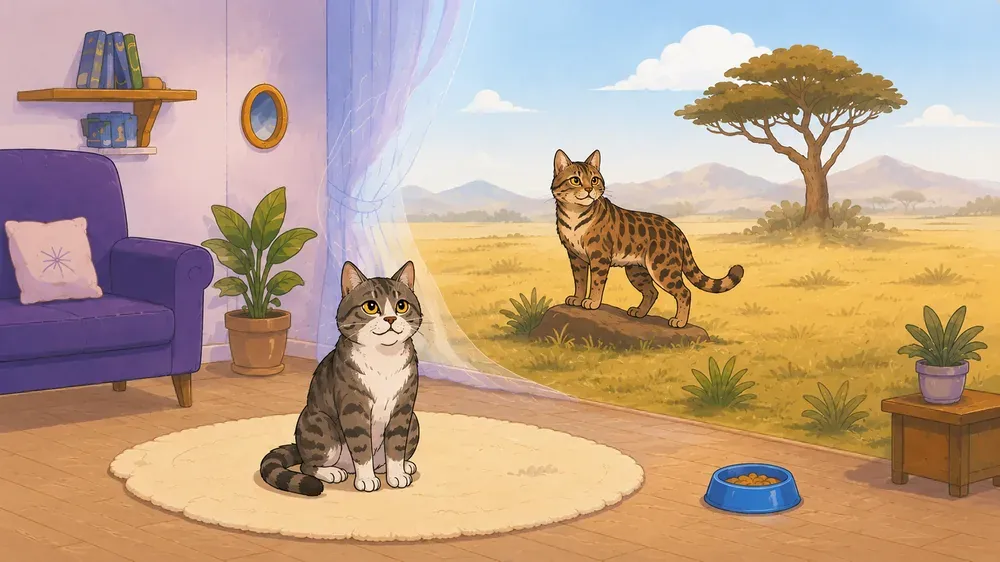
To understand the behavior of a house cat, you need to remember where it comes from. Its ancestor is the African wildcat, a solitary territorial predator.

1. Where cat habits come from: the past of a solitary hunter
To truly understand a house cat's reactions, you need to look into its past. Dogs descended from pack animals that know how to negotiate and make up after quarrels. But the ancestor of the domestic cat was the African wildcat — a committed loner. These predators lived alone, fiercely guarded their territory, and relied only on themselves. This history largely shapes the character of every cat today.
Even though cats have lived alongside humans for a long time, deep down they remain solitary hunters. However, they've turned out to be remarkably flexible: if there's plenty of food and the environment is calm, cats are quite capable of bonding both with other cats and with people.
A kitten learns to trust humans most easily during the so-called sensitive period — roughly from the second to the ninth week of life. But even the most affectionate cat needs, throughout its entire life, to feel that it's in control of the situation, understands what will happen next, and always has a way to retreat in case of danger.
Because cats have always lived alone, they never learned to display submission (the way dogs do to avoid a fight). When faced with a threat, a cat prefers to freeze, hide, or flee — it will only attack openly as an absolute last resort, when there's nowhere left to run. What's more, in the wild, showing pain or weakness is very dangerous — it makes you easy prey. Because of this instinct, cats are phenomenally good at hiding illness and severe pain, which often becomes a problem, since owners and even veterinarians don't always notice in time that an animal is unwell.
2. Body language: how cats talk without words
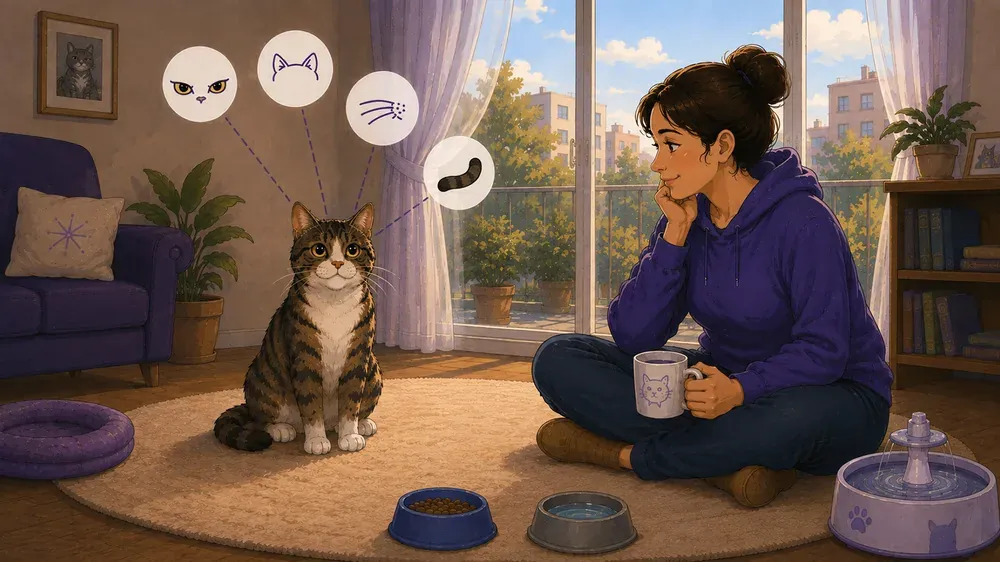
Cats are constantly communicating with the world, just not the way we do. They rarely use their voice, relying instead on body language: postures, tail movements, facial expressions, and muscle tension. To understand a cat, you need to look at the whole picture — judging by just one detail (say, only the tail) can lead you badly astray.
Tail position is an excellent mood indicator. A tail held straight up says the cat is confident, friendly, and ready to interact; if the tip curls like a question mark, that's a warm greeting. A relaxed tail held at back level or slightly lower means the cat is calm but still keeping an eye on things. If a cat is scared or anxious, it tucks its tail between its hind legs, trying to make itself as small as possible. But when badly frightened or ready to defend itself, the reaction is the opposite: the fur on the tail stands on end and it puffs up like a bottle brush — the animal is trying to look bigger and more intimidating.
Tail movements matter just as much. If just the tip twitches slightly, the cat is intensely focused on something or hunting. But if the tail starts lashing sharply and forcefully from side to side, that's a clear sign the cat is angry or irritated, and the stronger and faster the tail whips, the closer the cat is to lunging at something. Conversely, if the tail wraps gently around your leg, that's the feline equivalent of a hug.
Cat ears can not only pick up the faintest sounds but also reveal the subtlest shades of mood. Ears pointed forward and slightly outward signal relaxed curiosity. If they drop and splay out to the sides (the “airplane” position), the cat is uncomfortable and anxious. Ears pressed flat against the head are a sign of serious fear or readiness to fight (this protects them from injury). If one ear points forward and the other points back, the cat is confused and trying to listen to several things at once.
3. How to recognize hidden pain: the Feline Grimace Scale (FGS)
Since cats instinctively hide their illnesses, figuring out when they're in pain is very difficult. A cat in severe pain may not cry or meow at all — it may simply become listless and hide. To solve this problem, researchers at the University of Montreal developed a special scale (the Feline Grimace Scale, FGS) that lets you assess pain levels just from the animal's facial expression, with no complicated equipment needed.
This method is based on the fact that facial muscles contract reflexively in response to pain, and a cat can't control this. To assess a cat using this scale, you need to observe it for about 30 seconds while it's not sleeping, eating, or grooming. Five areas of the face are scored, each rated from 0 to 2 points, and the points are then added together. Studies have shown that a score of 4 or higher means the cat really is in significant pain and needs pain medication urgently.
It's important to remember that in flat-faced cats (Persians, for example), it's harder to judge tension in the muzzle and whiskers, but the eyes and ears will still give an accurate result.
4. Joy, trust, and affection: how cats show it
Cats don't have as rich a range of facial expressions as we or monkeys do. They show their joy and love through scent, posture, and sound. If you learn to notice these signals, you'll understand just how much your pet loves you.
One of the clearest signs of complete trust is the “slow blink.” When a cat looks at you and slowly closes its eyes, it's essentially saying, “I'm not going to attack” (among predators, a direct, unblinking stare is a challenge). Researchers have found that if a person slowly blinks back while looking at a cat, the cat is likely to respond in kind — it's a great way to deliberately show a cat that you're friendly.
Another important sign is when a cat rubs its cheeks, chin, or head against you: it has special glands on its face that release calming pheromones. This isn't just about begging for food — this is how the cat marks you as “one of its own,” adds you to its family, and shows that you're safe to be around.
If a cat sleeps next to you, pressed against your body, it means it's entrusting you with its safety. The highest degree of trust is when a cat sleeps on its back, paws sprawled out, exposing its belly: in nature, the belly is the most vulnerable spot, and a cat will only expose it somewhere it doesn't expect any danger. And when a cat brings you its toys or a mouse it's caught, that's also an act of caring passed down from its wild ancestors: it's sharing its catch with you and trying to “feed” you.
5. The secrets of purring: it's not just about pleasure
We tend to think that if a cat is purring, it must be perfectly happy. But science says it's much more complicated than that. Purring is produced by rhythmic contractions of the muscles in the larynx and diaphragm — scientists have even found special pads in cats' throats that can vibrate and generate this sound almost automatically as air passes through them.
Of course, cats purr when they feel good. But they've also learned to use purring to manipulate people. There's a so-called “solicitation” purr, which cats produce when asking for food or attention. Researchers found that hidden inside this sound is a high-pitched cry (at a frequency of 220-520 Hz) remarkably similar to a human infant's cry. Even people who've never owned a cat perceive this sound as urgent and distressing — it turns out cats have learned to exploit our parental instincts to get us to feed them faster.
But that's not all. Cats can also purr loudly when they're in severe pain, frightened, or giving birth. Some believe this is a form of self-healing: vibrations at purring frequencies (25 to 150 Hz) are thought to speed up wound healing, reduce inflammation, and even help broken bones knit faster.
In reality, it's important to remember that an animal may purr both out of joy, when hoping for a favorite treat, and in a state of high physiological stress.
6. Stress and the Cat Stress Score (CSS)
Stress in cats is a serious problem that can be acute (short-term) or chronic (ongoing). While acute stress (being startled by a vacuum cleaner or a trip to the vet) simply mobilizes the body's resources, chronic stress slowly destroys a cat's health: at first the body tries to adapt, but eventually exhaustion sets in and the animal becomes seriously ill. To help shelter workers and veterinarians more easily gauge how stressed a cat is, the Cat Stress Score (CSS) was created, rating condition on a scale from 1 to 7.
Non-obvious causes of stress and “nerve-related” illness. Owners often have no idea what's making their cat constantly on edge. For instance, cats hear ultrasound extremely well, so rodent-repelling devices or the hum of household appliances can drive them up the wall. Strong smells also bother them a great deal — air fresheners or citrus essential oils, for example. And if a cat has no way to climb up high (onto a shelf or cat tree) to survey the room from above, it will constantly feel vulnerable.
Ongoing stress and elevated levels of cortisol (the “stress hormone”) lead to real illness. The most common problem is idiopathic cystitis: the bladder becomes painful and inflamed with no bacteria involved at all, purely from nerves, which can make the cat run to the litter box frequently or start urinating outside it. Many people think the cat is “getting revenge,” but really it's just sick. Cats may also start licking themselves until large bald patches form, trying to self-soothe. And if stress causes a cat to stop eating, that's extremely dangerous: starvation in cats can very quickly (within just a few days) lead to a fatal liver disease.
7. The main mistakes owners make when interacting with cats
Because cats and humans perceive the world differently, our good intentions sometimes come across as frightening to them. Understanding these differences will help you live in harmony with your pet.
Petting mistakes: why a cat suddenly bites. The biggest mistake is assuming that if a cat rolls onto its back and shows its belly, it's asking for a belly rub. An exposed belly is a sign that the cat trusts you, but if you start petting it, the predator's instinct kicks in: the belly must be protected! The nerve endings there are extremely sensitive, so the cat immediately reaches for claws and teeth — not out of spite, but simply as an ancient self-preservation reflex.
The second common mistake is petting a cat too long and too firmly along its whole back, especially toward the tail. This area is packed with nerve endings. If you pet it for too long, the cat's nervous system becomes overloaded and it starts to feel unpleasant. The result is “petting-induced aggression”: a moment ago the cat was purring, and now it's biting your hand just to make you stop.
You should pet a cat the way cats groom each other as a sign of friendship.
8. Misunderstandings about behavior
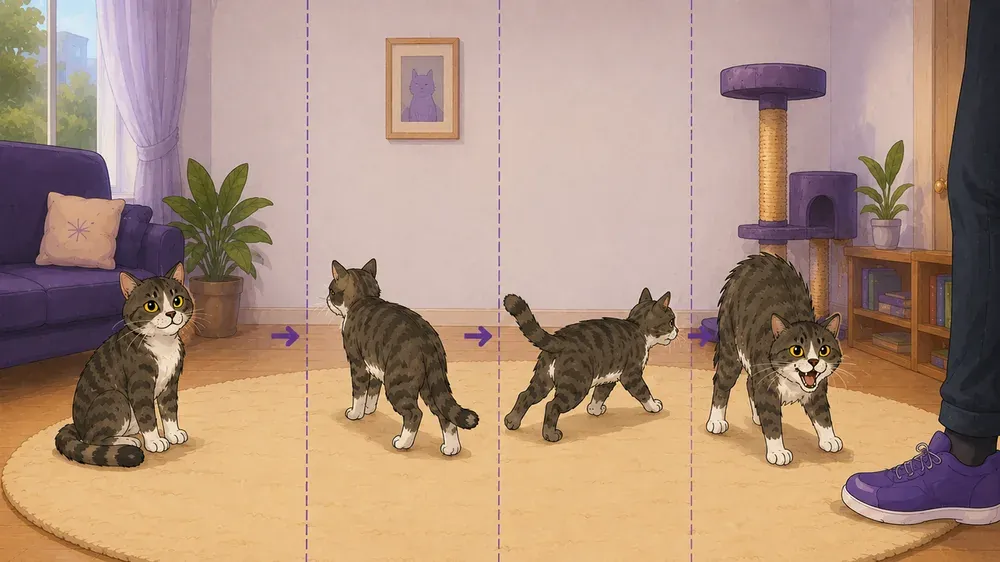
In many movies and cartoons, a cat with an arched back is a symbol of aggression and evil. But in real life, it all depends on the situation. If a cat arches its back while approaching you, with relaxed muscles and ears pointed forward, it's simply having a nice stretch and saying hello. But if that same posture comes with fur standing on end, stiff legs, and flattened ears, the cat is panicking and trying to look bigger to defend itself from an attack. If you try to pet it to “calm it down,” it will fight for its life and attack.
Another amusing misunderstanding has to do with scent. Often a cat will sniff something new (your shoes, say) and then freeze with its mouth slightly open and a somewhat dazed look. People tend to think the cat is expressing disgust. In fact, behind the front teeth on the roof of a cat's mouth is a special structure called the vomeronasal (Jacobson's) organ — an extra nose for analyzing the most complex scents and pheromones. By opening its mouth slightly, the cat directs scent molecules straight to it — so it's not wrinkling its face in disgust, it's thoughtfully and deeply analyzing the smell.
9. Don't force interaction, and respect personal boundaries
The world's leading veterinary organizations insist that the single most important thing for a cat's mental well-being is a sense of control. The most serious mistake owners can make is forcibly dragging a frightened cat out from under the couch or holding it in their arms while it struggles to get free. For a cat, which is a loner by nature, any loss of freedom feels, on an emotional level, like it's about to be killed.
If a cat is getting used to a new home, or is simply frightened (guests arriving, for example), always give it the chance to hide somewhere safe, ideally elevated off the floor.
And the golden rule: the cat should always be the one to initiate affection and play. Never force your company on it.
More in this section
The information in this app comes from open sources and the experience of cat owners. It does not replace a consultation or an examination by a vet. Decisions about your pet's health and care are the owner's to make — if in any doubt, contact a vet.
All of this is in the Cat First app
Articles, checklists and first aid on your phone, even without internet.